
Business owners usually do not ask this question just to compare marketing channels.
They ask because they want to know where the money is going.
If they spend on Google Ads, can they see what happened? If they invest in SEO, can they prove it worked? Can either one be tracked clearly enough to justify the cost?
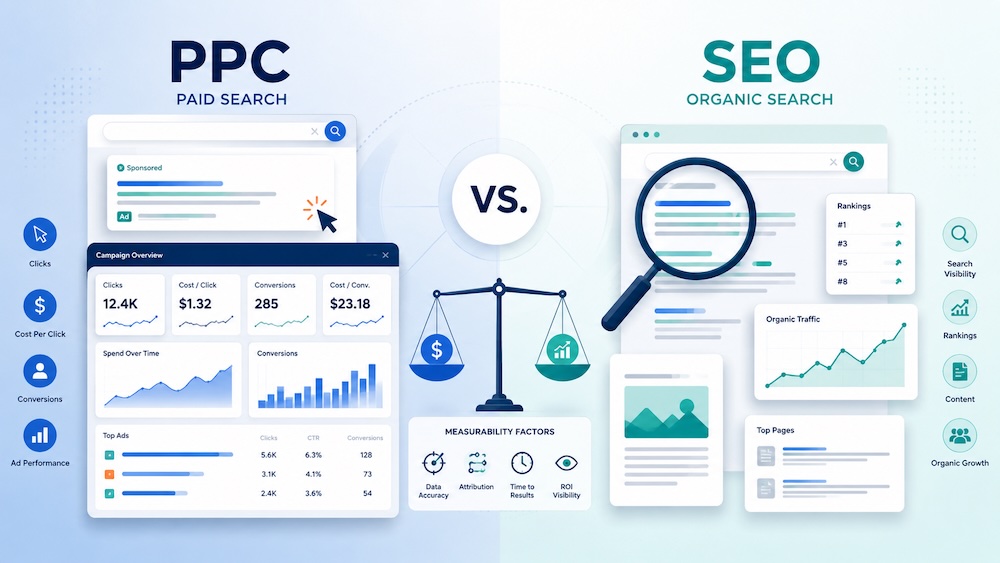
A common question is whether PPC or SEO is more measurable and quantifiable. The short answer is that PPC is usually easier to measure in the short term, while SEO requires a longer view of visibility, traffic, and attribution.
But here is the part that matters.
Easier to measure does not always mean better.
PPC usually gives cleaner short-term data. SEO can be harder to tie back to one exact action, but it can keep producing value long after the first round of work is done.
Quick Answer: PPC Is More Immediately Measurable
PPC is more measurable in the short term.
That is the honest answer.
With PPC, you can usually see how much you spent, how many people saw your ads, how many clicked, and how many converted. You can also tie those results back to campaigns, keywords, audiences, ads, and landing pages.
That makes reporting cleaner.
SEO is measurable too, but it does not always move in a straight line. A page may take time to rank. A person may find your site through organic search, leave, come back later, and convert through another channel.
That makes SEO harder to explain in a simple monthly report.
PPC gives you faster measurement. SEO gives you longer-term visibility that can be harder to attribute directly.
Our team of experts is here to help you navigate the complex landscape and drive real results.
TALK TO AN EXPERT →What Does “Measurable” Mean in Digital Marketing?
When people say a marketing channel is measurable, they usually mean they can track what happened.
Can you see where the traffic came from?
Can you see what people did after they clicked?
Can you see how many leads or sales were generated?
Can you see what each lead or sale cost?
That is what most business owners care about.
A channel is measurable when you can track performance. It is quantifiable when you can express that performance in numbers.
For PPC, those numbers may include:
- Cost per click
- Click-through rate
- Conversion rate
- Cost per lead
- Cost per sale
- Return on ad spend
- Revenue from ads
For SEO, those numbers may include:
- Keyword rankings
- Google Search Console impressions
- Organic clicks
- Organic traffic
- Organic leads
- Organic sales
- Local map visibility
- Non-branded traffic growth
So no, SEO is not some mystery channel that cannot be measured.
It can be measured.
It is just not always as direct as PPC.
Why PPC Is Easier to Measure
PPC Has a Clearer Spend-to-Result Connection
PPC is easier to measure because the money and the result usually sit closer together.
You spend money on ads. People click those ads. Some of those people fill out a form, call your business, book an appointment, or buy something.
That path is easier to follow.
With PPC, you can usually measure:
- Impressions
- Clicks
- Cost per click
- Conversion rate
- Conversions
- Cost per conversion
- Cost per lead
- Return on ad spend
- Search terms
- Landing page performance
That gives you something concrete to look at.
For example, if you spend $2,000 and get 20 leads, your cost per lead is $100 before management fees.
That does not tell the whole story, but it gives you a real starting point.
The next question is whether those leads were good.
That is where a lot of businesses get into trouble. They stop at cost per lead and never check lead quality.
A campaign can look great in Google Ads and still be bad for the business if the leads are junk.
PPC Data Comes Back Faster
PPC gives feedback quickly.
Sometimes too quickly.
If a keyword is wasting money, you can see it. If an ad is not getting clicks, you can see it. If a landing page is not converting, you can see that too.
You do not have to wait six months to learn something.
That is one of the biggest advantages of PPC. It helps you test faster.
SEO works differently.
A new service page may take time to rank. A blog post may start slow and grow over time. Technical SEO fixes may not show a clear impact right away. Google also needs time to crawl, test, and trust pages.
That makes SEO harder to measure in the first few weeks.
PPC is easier to measure because the cost of traffic and the results from that traffic are often recorded in the same system.
But PPC tracking is not perfect.
Not even close.
Bad conversion setup can make PPC look better than it is. Missing call tracking can hide good results. Broken forms can ruin a campaign. Duplicate conversions can inflate performance. Poor CRM data can make it impossible to know which leads actually turned into customers.
So yes, PPC is easier to measure.
But only when the tracking is set up correctly.
Why SEO Is Still Measurable
SEO Measurement Is Based on Visibility, Traffic, and Outcomes
SEO is measurable.
The problem is that too many people measure it the wrong way.
They look only at rankings.
Rankings matter, but they are not enough. Ranking for a keyword does not mean much if the page gets no traffic. Traffic does not mean much if it never turns into leads or sales.
Good SEO reporting should look at visibility, traffic, and outcomes together.
SEO can be measured through:
- Keyword rankings
- Google Search Console impressions
- Organic clicks
- Organic landing page traffic
- Organic conversions
- Local map visibility
- Non-branded traffic growth
- Indexed pages
- Assisted conversions
- Lead quality from organic search
The best SEO reporting answers business questions, not just marketing questions.
Are more people finding us?
Are they finding the right pages?
Are we showing up for service keywords or only our brand name?
Are organic visitors turning into real leads?
Are those leads worth anything?
That is what matters.
SEO Takes Longer to Quantify
SEO takes longer to quantify because the work compounds.
One page may rank for several searches. One article may support multiple service pages. One technical fix may help the whole site. One internal link update may improve the strength of a page over time.
That is good.
But it also makes measurement less clean.
A person might find your site through a blog post, leave, search your brand later, click your Google Business Profile, and then call.
Did SEO create that lead?
Partly, yes.
Will analytics always give SEO full credit?
Probably not.
That is why SEO can look weaker than it actually is if you only look at last-click attribution.
SEO is measurable, but it is usually less direct because organic search performance compounds across time, pages, and search queries.
PPC vs SEO Measurement: Side-by-Side Comparison
| Category | PPC | SEO |
|---|---|---|
| Speed of data | Faster | Slower |
| Cost tracking | Very direct | Less direct |
| Keyword-level visibility | Stronger in ad platforms | More limited |
| Attribution | Usually clearer | Often more complex |
| Testing speed | Faster | Slower |
| Long-term value | Stops when spend stops | Can compound over time |
| Reporting clarity | Easier for short-term reports | Better over longer periods |
| Best for | Fast feedback and lead generation | Long-term visibility and authority |
PPC is easier to report on month to month.
SEO is better judged over longer periods because the value often comes from building visibility that does not disappear the second you stop spending on ads.
That is the tradeoff.
PPC gives you cleaner short-term numbers.
SEO can give you longer-term search presence.
The Biggest Difference Is Attribution
Attribution is just a way of asking, “Which marketing channel deserves credit?”
With PPC, the answer is usually easier.
Someone clicks an ad. They land on a page. They fill out a form, call, book, or buy.
That does not mean the tracking is always right, but the path is easier to follow.
SEO is messier.
A person may:
- Read a blog post
- Leave the website
- Search the brand a week later
- Click the Google Business Profile
- Visit the site again
- Come back through a paid ad
- Convert days later
In that case, SEO may have started the relationship, but another channel may get the final credit.
This happens all the time.
PPC often gets clearer attribution because it captures the click closest to the conversion. SEO often influences the buyer earlier in the decision process.
That does not make SEO less valuable.
It just makes it harder to explain in a clean report.
Which Channel Gives Better ROI Data?
PPC ROI Is Easier to Calculate
PPC ROI is usually easier to calculate because the costs are clearer.
You can compare:
- Ad spend
- Management cost
- Conversions
- Revenue
- Customer value
- Close rate
Here is a simple example.
A business spends $2,000 on ads and gets 20 leads.
That means the cost per lead is $100 before management fees.
If 5 of those leads become customers, the cost per customer is $400 before management fees.
Now you can compare that against what a customer is worth.
That is useful.
But again, this only works if the lead data is real.
If the campaign brings in 20 leads and 15 of them are unqualified, the cost per lead number is misleading. The report may look good, but the business will feel the problem.
This is why PPC reporting should not stop inside the ad account.
You need to know which campaigns are producing qualified leads, booked appointments, closed deals, and revenue.
Not just form fills.
SEO ROI Is More Difficult, But Not Impossible
SEO ROI is harder to calculate because the cost and return are spread out over time.
You may pay for SEO work this month and see the real return months later. A page built today may bring in traffic next year. A local SEO improvement may drive more calls from Google Business Profile, even if those calls do not show up neatly inside your website analytics.
That does not mean SEO ROI is fake.
It means you need a better way to look at it.
SEO ROI can include:
- Leads from organic traffic
- Organic sales
- Reduced dependency on paid ads
- Rankings for high-intent terms
- Increased branded search
- Long-term traffic from existing pages
- More visibility across the buyer journey
PPC ROI is easier to calculate in the short term. SEO ROI is often clearer after the work has had time to compound.
Is PPC Better Than SEO Because It Is More Measurable?
No.
This is where people make the wrong jump.
PPC being easier to measure does not automatically make it the better investment.
PPC requires ongoing spend. When you stop paying, the traffic stops.
SEO requires time, content, technical work, and patience. But once it starts working, it can keep bringing in traffic without paying for every click.
That does not make SEO free.
It is not free.
You still pay for strategy, writing, development, optimization, and reporting. But the return can last longer.
The most measurable channel is not always the most valuable channel.
A business that only invests in what is easiest to track may miss the work that builds authority, trust, and long-term visibility.
How to Measure PPC Correctly
PPC measurement starts with tracking.
If tracking is wrong, the report is wrong.
To measure PPC correctly, you should:
- Track form submissions
- Track phone calls
- Track purchases or booked appointments
- Use proper conversion actions
- Separate primary and secondary conversions
- Review search terms
- Monitor cost per qualified lead, not just cost per lead
- Connect leads to CRM or sales data when possible
- Test landing pages
The biggest mistake is treating every conversion like it has the same value.
A 5-second phone call is not the same as a real sales call.
A spam form is not the same as a qualified inquiry.
A newsletter signup is not the same as a booked appointment.
This is why PPC reporting has to connect to the sales process. Otherwise, you are only seeing part of the picture.
The ad account may tell you what generated the cheapest lead.
The business needs to know what generated the best lead.
How to Measure SEO Correctly
SEO should not be judged by rankings alone.
Rankings are useful, but they are only one piece.
To measure SEO correctly, you should:
- Use Google Search Console for impressions and clicks
- Use analytics to track organic landing pages
- Track organic form fills and calls
- Separate branded and non-branded traffic
- Monitor rankings for important service keywords
- Track local visibility if relevant
- Review assisted conversions where possible
- Compare performance over 3, 6, and 12 months
You also need to look at intent.
Not all traffic is equal.
A person searching for a quick definition is not the same as a person searching for a service near them. A blog visitor may be early in the process. A service page visitor may be closer to taking action.
That matters when judging SEO.
The goal is not just to get more traffic.
The goal is to get the right traffic and turn some of that traffic into business.
When PPC Is the Better Choice
PPC is usually the better choice when you need data quickly.
If you are launching a new service, testing a new offer, or trying to generate leads now, paid search can get you in front of people faster.
PPC is usually better when:
- You need leads quickly
- You want faster testing
- You need clearer short-term reporting
- You are launching a new service
- You want to test offers, landing pages, or keywords
- You have a defined budget and need predictable tracking
PPC can also help when SEO competition is tough.
If it will take months to rank organically, paid search can help you show up while SEO is building in the background.
But PPC will also expose weak spots fast.
If your landing page is confusing, the offer is weak, the form is broken, or the sales team does not follow up, you will feel it.
That can be frustrating.
It can also be useful, because now you know what needs to be fixed.
When SEO Is the Better Choice
SEO is usually the better choice when you are thinking long term.
If people search for your services, your products, or the problems you solve, SEO can help you show up before they ever click an ad.
SEO is usually better when:
- You want long-term visibility
- Your market has strong search demand
- You want to reduce dependency on paid ads
- You can invest for several months
- You need content that builds authority
- You want to rank for informational and service-related searches
SEO is especially useful when buyers do research before making a decision.
That happens in a lot of industries.
Healthcare. Legal. Home services. Finance. Software. Education. Real estate. Professional services.
People search. They compare. They read. They look for proof. They ask questions before they contact anyone.
SEO helps you show up during that process.
Why Many Businesses Should Use PPC and SEO Together
For many businesses, the best answer is not PPC or SEO.
For a treatment-provider application, see our rehab digital marketing strategy guide.
It is both.
PPC can show you what converts. SEO can help you build long-term visibility around those same topics.
If a PPC campaign shows that one keyword brings in strong leads, that keyword may deserve a dedicated SEO page.
If one landing page converts better than another, you can use those lessons across your organic pages.
If paid search shows that one offer is working, you can build more content around that offer.
The two channels can feed each other.
PPC gives faster feedback.
SEO builds staying power.
PPC can tell you what converts. SEO can help you earn long-term visibility for those same topics.
Final Verdict: PPC Is More Measurable, SEO Is More Compounding
PPC is more measurable and quantifiable in the short term because cost, clicks, and conversions are easier to connect.
SEO is still measurable, but it needs a longer timeline and a broader view of performance.
If you need fast feedback, PPC is easier to justify.
If you want long-term search visibility, SEO is worth building.
If you want both, the better move is to use PPC and SEO together with tracking that actually connects marketing activity to real business outcomes.
Brand House helps businesses understand what their marketing is actually producing, whether that means improving Google Ads performance, building SEO visibility, or creating a strategy that uses both channels together.
FAQs
Is PPC more measurable than SEO?
Yes. PPC is usually more measurable in the short term because ad spend, clicks, conversions, and cost per lead can be tracked more directly.
Is SEO measurable?
Yes. SEO can be measured through rankings, impressions, organic clicks, organic traffic, leads, sales, and local visibility. The challenge is that SEO usually takes longer and attribution is less direct.
Which has better ROI, SEO or PPC?
PPC usually provides faster ROI data. SEO may provide stronger long-term value if the site earns rankings that continue driving traffic and leads.
Should I invest in SEO or PPC first?
If you need leads quickly, PPC is usually the better starting point. If you want long-term visibility and can wait for results, SEO is worth investing in. Many businesses benefit from using both.
Brand House builds campaigns around search intent, budget control, landing pages, conversion tracking, and lead quality — so you generate qualified leads instead of just buying traffic.
TALK TO AN EXPERT →