
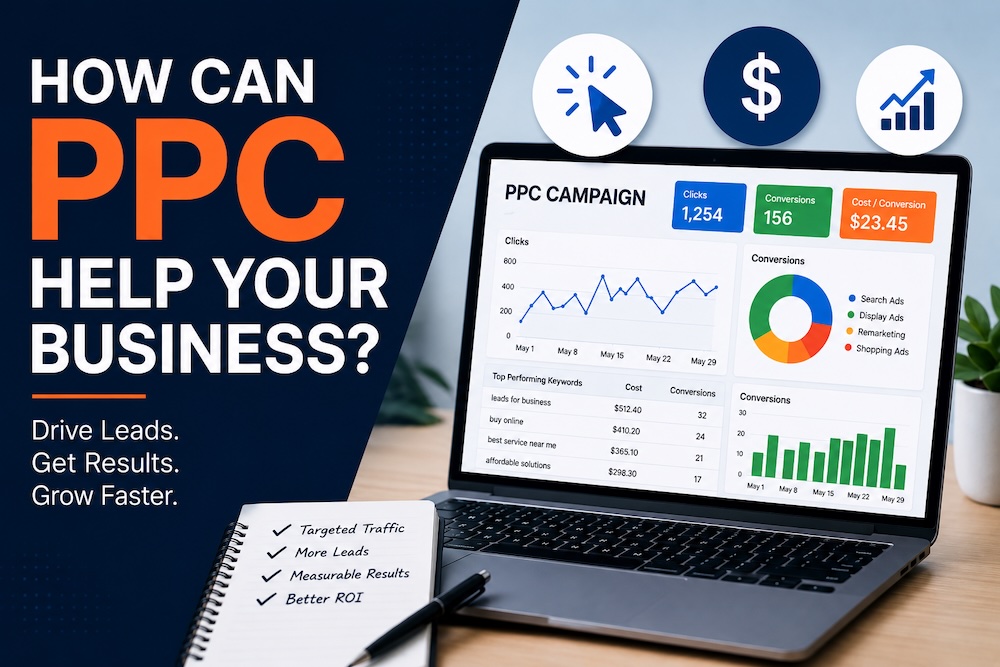
PPC can help your business get in front of people who are actively searching for your products or services. Instead of waiting for organic rankings to improve over time, pay-per-click advertising allows you to show ads in search results, drive traffic to your website, and start testing what turns visitors into leads or customers.
But PPC is not just about buying clicks.
It works best when the campaign is built around search intent, budget control, landing page quality, conversion tracking, and ongoing optimization. Without those pieces, PPC can become expensive quickly.
So the real question is not just whether PPC can help your business. The better question is how PPC can help your business in a way that leads to measurable results.
What PPC Means for a Business
PPC stands for pay-per-click. It is a form of digital advertising where you pay when someone clicks on your ad.
One of the most common forms of PPC is Google Ads. With Google Ads, your business can appear when people search for specific keywords related to what you offer.
For example, a plumber may want to show up when someone searches for “emergency plumber near me.” A dentist may want to show up for “dental implants near me.” A rehab center may want to show up for treatment-related searches in its service area.
Unlike traditional advertising, PPC gives you more control over who sees your ads, where they appear, how much you spend, and what actions you want people to take after clicking.
That control is one of the biggest reasons businesses use PPC as part of their marketing strategy.
Our team of experts is here to help you navigate the complex landscape and drive real results.
TALK TO AN EXPERT →PPC Can Put You in Front of People Already Searching
One of the strongest benefits of PPC is that it can put your business in front of people who are already looking for what you offer.
This is different from advertising to a broad audience and hoping someone is interested. Search ads are based on intent. Someone types a search into Google because they are looking for an answer, a service, a product, or a provider.
If your ad appears at the right moment, PPC can help you capture demand that already exists.
That is especially valuable for businesses that rely on leads, calls, form submissions, appointments, consultations, or service requests.
For example, someone searching for “Google Ads agency” is likely in a different stage than someone reading a general article about marketing. PPC allows you to target those higher-intent searches directly.
PPC Can Generate Leads Faster Than SEO
SEO can be a strong long-term growth channel, but it usually takes time. A new page may take months to rank, and a competitive keyword may require ongoing content, technical improvements, and authority building before it performs.
PPC can move faster.
Once a campaign is built, ads can start showing quickly. That makes PPC useful when your business needs leads sooner or wants to test a market before investing heavily in a long-term organic strategy.
This does not mean PPC is always better than SEO. They serve different purposes. PPC can give you faster visibility and data, while SEO can build long-term organic traffic over time.
This does not mean PPC is always better than SEO. They serve different purposes. PPC can give you faster visibility and data, while SEO can build long-term organic traffic over time. If you are comparing both channels, this guide on whether PPC or SEO is more measurable explains how each channel is tracked and why PPC often provides faster performance feedback.
PPC Helps You Control Where Your Budget Goes
PPC gives businesses more budget control than many traditional forms of advertising.
You can control:
- How much you spend per day
- Which keywords you target
- Which locations your ads show in
- Which services you promote
- What landing page people visit
- When your ads are eligible to show
- Which campaigns receive more or less budget
This control matters because not every service, keyword, or location has the same value.
A business may want to spend more on its highest-margin service and less on lower-value searches. Or it may want to focus only on a specific city, county, or service area.
PPC allows you to make those decisions more directly.
Budget still needs to be realistic. If the daily budget is too low for the cost per click in your market, the campaign may not collect enough data to improve. If you are unsure what a starting budget should look like, this Google Ads budget estimator can help you think through spend, lead goals, and expected cost per lead.
PPC Makes Marketing Easier to Measure
One of the biggest advantages of PPC is measurement.
With the right setup, you can see which campaigns, keywords, ads, and landing pages are producing results.
A properly tracked PPC campaign can help you understand:
- How many people clicked your ads
- Which keywords drove traffic
- Which ads generated calls or form submissions
- How much each lead cost
- Which landing pages converted best
- Which searches wasted budget
- Whether the campaign is producing qualified leads
This data can make marketing decisions easier. Instead of guessing which message, keyword, or service is working, PPC gives you direct feedback.
But tracking has to be set up correctly. If calls, forms, booked appointments, or purchases are not being tracked properly, the campaign may look better or worse than it actually is.
Clicks alone are not enough. A business should care about whether those clicks become leads, and whether those leads are worth paying for.
PPC Helps You Test Offers, Services, and Messaging
PPC is not only useful for lead generation. It can also help you test what your market responds to.
Because PPC campaigns can collect data quickly, you can use them to test:
- Different offers
- Different headlines
- Different landing pages
- Different services
- Different calls to action
- Different locations
- Different audience segments
This is helpful because what a business thinks will work is not always what the market responds to.
For example, one landing page may get traffic but few leads. Another page with clearer messaging, stronger proof, and a better call to action may convert better.
PPC gives you a way to learn faster.
That data can also improve other parts of your marketing. If a certain offer or message performs well in PPC, it may also be useful for SEO pages, landing pages, email campaigns, and sales conversations.
PPC Can Support SEO While Organic Rankings Take Time
PPC and SEO can work together.
SEO is usually better for long-term organic visibility, but it can take time to build. PPC can help fill the gap while your organic rankings are still growing.
This is especially useful for newer websites, new service pages, new locations, or competitive markets where SEO will take longer to gain traction.
PPC can also help you learn which keywords convert before investing heavily in SEO content. If a keyword drives qualified leads through paid search, it may be worth targeting organically as part of a longer-term SEO strategy.
That does not mean every PPC keyword should become an SEO target. Some keywords are too competitive, too broad, or too expensive to pursue in every channel. But PPC data can help make SEO decisions more informed.
PPC Can Help Local Businesses Reach the Right Area
For local businesses, PPC can help control where ads appear.
A business can target specific cities, neighborhoods, counties, or service areas. That means your ads can focus on the locations where you actually want customers.
This is useful for businesses like:
- Home service companies
- Dental practices
- Law firms
- Medical and wellness providers
- Addiction treatment centers
- Local service providers
- Businesses with specific service territories
Local targeting helps reduce wasted spend from people outside your service area.
But location targeting still needs to be reviewed. A campaign may bring in traffic from areas that are not profitable or not serviceable if the settings, keywords, or search terms are not managed correctly.
PPC Can Bring Back People Who Already Visited Your Website
Not every visitor becomes a lead the first time they visit your website.
Some people compare options. Some come back later. Some need more trust before they call, book, or submit a form.
PPC can help you stay in front of people who have already interacted with your business through remarketing or retargeting campaigns.
For example, someone may visit your service page, leave without converting, and later see an ad that brings them back to your website.
This can be useful when the buying decision takes time or when people are comparing multiple providers.
Remarketing should still be used carefully. The message should match where the person is in the decision process, and the campaign should not waste budget showing ads to people who are unlikely to become customers.
PPC Helps You Learn Which Searches Are Worth Paying For
One of the most useful parts of PPC is seeing the actual searches that trigger your ads.
This can help you understand how people describe their problem, what services they are looking for, and which searches are not worth paying for.
For example, a campaign may target a keyword that sounds relevant, but the actual search terms may include people looking for jobs, definitions, free help, or services you do not offer.
That is where optimization matters.
A well-managed PPC campaign should review search terms, add negative keywords, adjust bids, improve ads, and move budget toward the searches that are more likely to produce qualified leads.
If this is not managed, PPC can waste money quickly. This guide on wasted spend in Google Ads explains how budget can leak from poor targeting, weak search terms, and under-optimized campaigns.
When PPC Does Not Help Your Business
PPC can be powerful, but it is not automatically the right move for every business.
PPC may not help much if:
- Your budget is too low for your market
- Your website or landing page does not convert
- You do not have conversion tracking in place
- Your offer is unclear
- Your sales team does not follow up with leads
- You are targeting keywords with weak intent
- You judge performance only by clicks instead of lead quality
This is why PPC should not be treated as just turning on ads.
The campaign needs to be connected to a real business goal. If the goal is leads, then the campaign should be judged by lead volume, lead quality, cost per lead, and whether those leads turn into customers.
If the landing page is weak, the tracking is broken, or the search terms are too broad, PPC may create traffic without creating business value.
What You Need Before Running PPC Ads
Before spending money on PPC, your business should have a few key pieces in place.
At minimum, you should know:
- What service or product you want to promote
- What locations you want to target
- What a lead or customer is worth
- What budget you can realistically test with
- What action you want users to take
- How you will track calls, forms, purchases, or appointments
- Where ad traffic will land after someone clicks
You do not need to have everything perfect before launching, but the basics matter.
If you do not know what a customer is worth, it becomes harder to decide what cost per lead is acceptable. If you do not have tracking in place, it becomes harder to know which parts of the campaign are working.
That is why PPC management includes more than creating ads. It usually includes campaign structure, keyword research, targeting, ad copy, landing page direction, conversion tracking, reporting, and ongoing optimization. You can learn more about what PPC management includes if you are deciding whether to manage ads yourself or hire help.
How Much Should You Spend on PPC?
There is no single PPC budget that works for every business.
The right budget depends on your industry, location, competition, cost per click, conversion rate, and lead goals.
A business in a highly competitive market may need a larger budget to collect meaningful data. A business in a smaller local market may be able to start with less, but still needs enough budget to generate clicks and conversions consistently.
The goal is not just to spend as little as possible. The goal is to spend enough to test properly while keeping the campaign focused on the searches most likely to create business value.
If you are trying to decide on a starting point, this article on how much a small business should spend on Google Ads can help you think through budget ranges and what impacts monthly spend.
How to Know If PPC Is Worth It
PPC is worth it when the campaign produces business value that justifies the cost.
That does not always mean every campaign is profitable immediately. Some campaigns need time to collect data, improve targeting, test landing pages, and refine the message.
But over time, you should be able to answer questions like:
- How much are we spending?
- How many leads are we getting?
- What is the cost per lead?
- Are the leads qualified?
- Which campaigns are driving results?
- Which keywords are wasting money?
- Are leads turning into customers?
- Does the return justify the spend?
If you cannot answer those questions, the issue may not be PPC itself. The issue may be tracking, reporting, campaign structure, or lead follow-up.
PPC should make your marketing more measurable, not more confusing.
PPC Works Best When the Strategy Is Built Around Leads
PPC can help your business by driving targeted traffic, generating leads faster, testing offers, controlling budget, and making performance easier to measure.
But PPC does not work well when the strategy stops at clicks.
The real value comes from connecting the campaign to the full path from search to lead to customer. That means choosing the right keywords, writing ads that match intent, sending traffic to strong landing pages, tracking conversions properly, and optimizing based on lead quality.
When those pieces are aligned, PPC can become one of the most direct ways to reach people who are already looking for what your business offers.
Need Help Turning PPC Into Qualified Leads?
Brand House helps businesses build PPC campaigns around search intent, budget control, landing pages, conversion tracking, and lead quality.
If you want to use PPC to generate more qualified leads instead of just buying traffic, we can help you create a campaign strategy built around measurable business results.
Brand House builds campaigns around search intent, budget control, landing pages, conversion tracking, and lead quality — so you generate qualified leads instead of just buying traffic.
TALK TO AN EXPERT →