
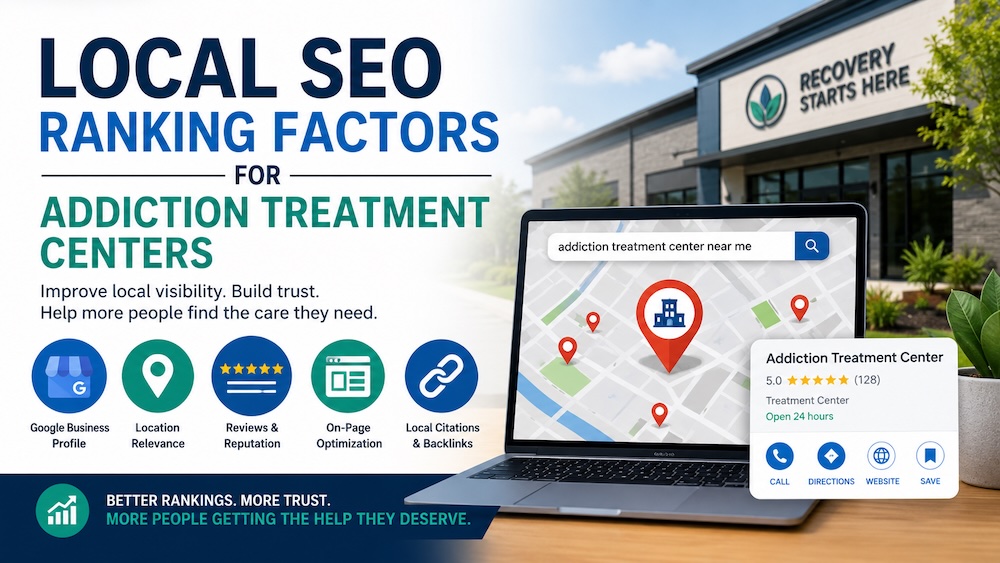
Local SEO is an important part of rehab SEO because it helps addiction treatment centers appear when people search for nearby rehab, detox, outpatient care, alcohol treatment, drug treatment, or dual diagnosis support. For many treatment centers, these searches are not casual. They often come from someone actively looking for help, a family member trying to understand options, or a loved one comparing facilities.
Ranking locally is not just about adding city names to a website. Google explains that local rankings are mainly based on relevance, distance, and prominence. For addiction treatment centers, that means your Google Business Profile, website pages, reviews, location signals, trust signals, backlinks, and tracking all need to work together.
This guide helps treatment-center owners and marketing teams decide what to check first: whether the profile accurately represents the facility, whether its website link leads to a useful page, whether reviews reveal a local gap, and whether inquiries are being measured. The sections below explain each area in more detail.
What Should a Rehab Center Check First?
Start by identifying the problem you are trying to solve. Limited visibility near the facility, weak visibility in a distant city, and website visits that produce few relevant inquiries need different checks. The examples below are illustrative starting points, not diagnoses of a specific treatment center.
| What you are seeing | What to check first | First action |
|---|---|---|
| The profile is missing or difficult to find even near the facility. | Verification, profile status, accurate business information, and categories that describe the actual facility. | Resolve profile issues and correct inaccurate information before expanding website content. |
| The profile appears nearby but performs poorly in more distant areas. | The searcher’s location, the facility’s real address, and results for the same query from comparable locations. | Separate distance limits from fixable profile or website issues. Adding city names does not change the facility’s location. |
| People reach the website but cannot easily understand the program or contact the facility. | The page linked from the profile, location and care-level details, mobile call buttons, and forms. | Fix the destination page and contact path before sending more visitors to it. |
| Comparable nearby facilities have a stronger review profile. | Review volume, ratings, recent feedback, and the experience behind that feedback. | Address recurring concerns and review how honest feedback is requested. Avoid treating a review count as a ranking target. |
| Reports show visibility or clicks, but inquiry quality is unclear. | Website tracking, source information, repeat contacts, and admissions-team feedback. | Define a relevant inquiry and verify measurement before judging whether local SEO is working. |
Our recommended order is to correct profile and program information, test the linked website page, compare reviews with similar nearby facilities, and verify inquiry measurement. Record a baseline as you begin so later changes can be evaluated against the same queries, locations, and reporting periods.
Our team of experts is here to help you navigate the complex landscape and drive real results.
TALK TO AN EXPERT →What Our 200-Profile Google Maps Study Adds
Brand House reviewed 200 treatment-related Google Business Profiles across 20 U.S. cities. In our comparison of Maps list positions 1–3 and 8–10, with 60 profiles in each group, the higher-position group had a median of 92 reviews compared with 62.5 in the lower-position group. Among profiles with website links, 32.2% of the higher group linked beyond the homepage, compared with 17.2% of the lower group.
These observations suggest useful checks: compare your review profile with similar facilities in your market, and inspect whether your website destination clearly represents the location and its programs. They do not establish a required review count or prove that changing a website link improves rankings. A useful homepage may still be the right destination for a single-location facility.
This was an observational review of Maps list results, not a ranking experiment or a study of the three-result local pack. It cannot isolate the effect of distance or other differences between facilities. Read the full rehab Google Maps study and methodology for the findings and limitations. Google’s local ranking guidance remains the source for its relevance, distance, and prominence framework.
What Local SEO Means for Addiction Treatment Centers
Local SEO is the process of improving visibility for searches connected to a specific area. For addiction treatment centers, that can include searches like:
- drug rehab near me
- alcohol rehab near me
- detox center in Los Angeles
- outpatient rehab in Orange County
- dual diagnosis treatment near me
- addiction treatment center in [city]
Local SEO affects more than Google Maps. It can also impact the local pack, organic city pages, service pages, branded searches, calls, form submissions, insurance verification requests, and admissions inquiries.
For a treatment center, local SEO is not only about getting more traffic. It is about being visible when someone is ready to ask for help.
How Google Ranks Local Addiction Treatment Centers
Google says local search results are based mainly on three factors: relevance, distance, and prominence. Understanding these three areas helps explain why one treatment center may show up in Google Maps while another does not.
Relevance
Relevance is how well your business matches what someone searched for. A treatment center needs to make its services clear across its Google Business Profile and website.
This includes your primary category, secondary categories, services, business description, website content, location page, treatment program pages, and city-specific pages.
If your website only says “addiction treatment” in broad terms, but does not clearly explain detox, residential treatment, outpatient care, alcohol rehab, drug rehab, or dual diagnosis treatment, Google and users may have a harder time understanding what you actually offer.
Distance
Distance is how far the business is from the searcher or from the location used in the search. This matters a lot for “near me” searches and city-based searches.
A treatment center with one real location may be able to rank in nearby areas, but it should not expect to rank equally across an entire state or region just because it added many city names to the site. Physical location still matters.
Prominence
Prominence is how well-known and trusted the business appears to be. Google says prominence can be based on information from across the web, including links, articles, directories, reviews, and ratings.
For addiction treatment centers, prominence can come from a combination of strong reviews, relevant local citations, healthcare-related directories, community partnerships, local mentions, quality backlinks, trusted website content, accreditations, and a recognizable brand.
Google Business Profile Optimization for Treatment Centers
A treatment center’s Google Business Profile is one of the most important pieces of local SEO. It is often the first thing someone sees before calling, visiting the website, checking reviews, or asking for directions.
Google recommends keeping business information complete and accurate because complete profiles are easier to match with relevant local searches. Google also says businesses should keep important information such as address, phone number, business category, and hours accurate in their profile. You can review Google’s guidance on improving local ranking on Google.
Use the right business categories
Categories help Google understand what the business is. Google’s Business Profile guidelines say to use the fewest number of categories needed to describe the overall core business and to choose categories that are specific but accurate.
For a treatment center, the category should describe what the business is, not every service it offers. Google explains this in its guidelines for representing your business on Google.
Do not keyword-stuff the business name
A common local SEO mistake is adding keywords to the Google Business Profile name, such as “Best Drug Rehab Los Angeles Detox Center.” This is risky. Google says the business name should reflect the real-world name used on signage, the website, stationery, and by customers. Google also says unnecessary information in the business name is not permitted and could result in suspension.
For treatment centers, the safer approach is to use the real business name and place service, city, and treatment information in the correct profile fields and website pages.
Keep the profile complete
A strong profile should include accurate information for:
- business name
- address or service area, when applicable
- phone number
- website URL
- hours
- business categories
- services
- business description
- photos
- review responses
For addiction treatment centers, photos can help create trust. Where appropriate, add real photos of the facility exterior, interior, treatment environment, admissions area, and staff. Avoid stock images when real photos can better show credibility.
Avoid fake addresses and virtual office tactics
Some businesses try to create local rankings by using fake addresses, virtual offices, or mailbox locations. This is a bad strategy. Google says businesses should create profiles for actual, real-world locations. Google also says P.O. boxes and remote mailboxes are not acceptable, and that virtual offices are not eligible if the business does not operate from that location.
Google’s guidelines also state that businesses cannot list an office at a coworking space unless it has clear signage, receives customers during business hours, and is staffed by the business during those hours. Treatment centers should avoid shortcuts that could create suspension, trust, or compliance problems.
Reviews and Reputation Signals
Reviews matter for both rankings and conversions. Google says more reviews and positive ratings can improve local ranking, and that positive reviews and helpful replies can help a business stand out. This is explained in Google’s documentation on local ranking factors.
For addiction treatment centers, reviews need to be handled more carefully than they would be for a restaurant, contractor, or retail business. Addiction treatment is personal and sensitive. A review response should never confirm that someone was a patient, reveal private information, or create the appearance that the center is discussing someone’s care publicly.
Google’s Business Profile guidelines say Google does not allow content or solicitation of content that contains private or confidential information, including sensitive records and other personal information. That guidance is especially important for behavioral health and addiction treatment providers.
What a strong review strategy should focus on
- earning reviews in an ethical and privacy-conscious way
- responding professionally without confirming patient status
- avoiding copy-paste responses when possible
- monitoring review quality and recency
- addressing negative feedback carefully
- not incentivizing or pressuring people for reviews
The goal is not just to get more reviews. The goal is to build a review profile that looks real, recent, trustworthy, and responsibly managed.
Compare your review volume, rating, and recent feedback with similar treatment facilities nearby. There is no universal review count that guarantees local visibility. Use the comparison to identify gaps in feedback and service experience, then build a responsible process for requesting honest reviews without incentives, pressure, or disclosure of private information.
Website Optimization for Local Addiction Treatment SEO
Google Business Profile matters, but the website still plays a major role in local SEO. A treatment center’s website should clearly explain where the center is located, what areas it serves, what treatment programs it offers, who the programs are for, how admissions works, and why someone should trust the facility.
At minimum, the website should make these things easy to understand:
- the primary location of the treatment center
- nearby cities or areas served
- levels of care offered
- substance use and mental health conditions treated
- insurance or payment options
- admissions process
- clinical credentials and trust signals
- how to call, contact, or verify insurance
This is where many treatment center websites fall short. They may have a decent homepage and a contact page, but the rest of the site does not clearly support local search intent. If someone searches for “alcohol rehab in Los Angeles,” the website should have a relevant page that answers that search better than a generic services page.
The homepage should establish location and services
The homepage should quickly explain what the center does and where it is located. For example, a strong homepage introduction might say:
[Treatment Center Name] is an addiction treatment center in Los Angeles offering detox, residential treatment, outpatient care, and dual diagnosis support.
That type of statement helps visitors and search engines understand the business quickly. It is not keyword stuffing. It is basic clarity.
Location pages should represent real locations
If a treatment center has a real physical location, that location should have a dedicated page. The page should include:
- business name
- address
- phone number
- embedded map
- directions or nearby landmarks
- facility photos
- hours, if applicable
- services offered at that location
- nearby areas served
- admissions CTA
This also lines up with Google’s Business Profile guidance that businesses should provide a phone number that connects to the individual business location or a website that represents the individual location.
Service pages should support local intent
Each core treatment service should usually have its own dedicated page. A treatment center should not rely only on one broad “services” page.
Examples of service pages include:
- Drug Rehab in [City]
- Alcohol Rehab in [City]
- Detox Program in [City]
- Residential Treatment in [City]
- Outpatient Treatment in [City]
- Dual Diagnosis Treatment in [City]
- Medication-Assisted Treatment in [City], if applicable
A strong service page should explain who the program is for, what the process looks like, what level of care is provided, what conditions or substances are treated, how admissions works, and how someone can contact the center.
The page should include local relevance naturally. It should not repeat the same city keyword over and over. Google’s spam policies warn against keyword stuffing, including blocks of text listing cities and regions a page is trying to rank for.
City Pages and Service Area Pages
City pages can help addiction treatment centers rank for local searches, but only when they are built correctly. A city page should not be a duplicated page where only the city name changes.
Google’s spam policies warn against doorway abuse, including pages created to rank for specific, similar search queries that lead users to substantially the same destination. Google specifically references pages targeted at specific regions or cities that funnel users to one page.
That does not mean city pages are always bad. It means city pages need to be genuinely useful.
When city pages make sense
City pages can make sense when a treatment center serves nearby areas and can provide useful information for people in those communities. For example, a Los Angeles facility may serve people from Santa Monica, Pasadena, Glendale, Burbank, or Long Beach.
A useful city page should explain how the center serves that area, how far the facility is, what treatment options are available, what someone should know before calling, and how admissions works.
What a strong city page should include
- specific city or area being served
- distance or directions to the treatment facility
- services available to people from that area
- local admissions context
- insurance or payment information
- local FAQs
- links to relevant treatment program pages
- links to the main location page
- real facility photos
- clear CTA to call or verify insurance
Even if a treatment center only serves one city, the website still needs to reflect that location clearly. The homepage, service pages, about page, contact page, and footer should all make the location easy to understand.
What to avoid
- creating dozens of nearly identical city pages
- changing only the city name from page to page
- listing every nearby city in a large keyword block
- claiming to have locations where no real location exists
- using fake addresses or virtual offices for map visibility
- creating pages that do not help the user make a better decision
City pages should help people, not just chase rankings.
Trust Signals Matter More for Addiction Treatment SEO
Addiction treatment is a high-trust category. People want to know who they are contacting, whether the center is legitimate, what type of care is offered, and whether they can safely ask for help.
Google’s guidance on helpful, reliable, people-first content explains that its systems look for signals that demonstrate experience, expertise, authoritativeness, and trust, also called E-E-A-T. Google also explains that topics that can affect health, safety, financial stability, or well-being may require a higher level of trust.
For addiction treatment centers, trust signals are not just SEO details. They affect whether someone feels comfortable making a call.
Trust signals to include on the website
- licenses
- accreditations
- clinical leadership
- staff bios
- medical reviewers, where appropriate
- facility photos
- insurance information
- admissions process
- privacy-conscious language
- clear contact information
- real author or reviewer bios for educational content
Google’s helpful content guidance also encourages content to make authorship clear when readers would expect it. For treatment-related educational content, author bios, clinical reviewer bios, and clear sourcing can help improve trust.
Educational Content That Supports Local Rehab SEO
Treatment centers should create content that answers real questions people ask before calling. This can support local SEO by building topical depth and helping visitors understand their options.
Good educational content should not be written only to target keywords. Google says helpful content should be created for people first, not primarily to attract search engine visits.
Content topics that can support addiction treatment SEO
- How to choose a rehab center in [City]
- Detox vs residential treatment
- Inpatient vs outpatient rehab
- Does insurance cover addiction treatment?
- What happens during admissions?
- What to expect during detox
- How long does rehab last?
- How to help a loved one get treatment
- Signs someone may need treatment
- Alcohol rehab vs drug rehab
Localized content examples
- What to Know About Going to Rehab in Los Angeles
- How to Find Drug Rehab in Southern California
- What Families Should Ask Before Choosing an Addiction Treatment Center in [City]
The best content helps someone understand care options, make a better decision, and feel safer reaching out.
Backlinks, Citations, and Local Authority
Local SEO does not only happen on your own website. Google’s local ranking guidance explains that prominence can be influenced by information across the web, including links, articles, directories, reviews, and ratings.
Citations help confirm that the business exists and that the name, address, phone number, and website are consistent. Backlinks can help build authority when they come from relevant and trustworthy sources.
Citation opportunities
- Google Business Profile
- Bing Places
- Apple Business Connect
- Yelp
- BBB, if applicable
- local chamber of commerce
- local business directories
- healthcare directories
- professional associations
- treatment-related directories, when appropriate
Backlink opportunities
- local partnerships
- community organizations
- podcasts and interviews
- expert quotes
- local news mentions
- clinician contributor profiles
- legitimate sponsorships
- educational resources worth linking to
The goal is not to get listed anywhere possible. Relevance and legitimacy matter. Google’s spam policies warn against link spam, including links created primarily to manipulate rankings.
Technical SEO and Website Experience
Technical SEO will not fix a weak Google Business Profile, thin content, or a bad review profile. But technical problems can hold back an otherwise strong website.
Treatment center websites should be easy to crawl, easy to navigate, fast enough for users, mobile-friendly, secure, and built around clear conversion paths.
Technical SEO items to review
- mobile-friendly design
- fast-loading pages
- SSL security
- clean URL structure
- proper title tags and meta descriptions
- crawlable internal links
- indexable service and location pages
- fixed broken links and redirects
- image alt text
- duplicate content issues
- call buttons that work on mobile
- forms that submit properly
Use structured data carefully
Google’s documentation on LocalBusiness structured data explains that structured data can help Google understand business details such as address, hours, and departments. Schema is not a magic ranking boost, but it can help search engines better understand the business.
Treatment centers should consider structured data for local business details, organization information, FAQs where appropriate, and article content where applicable.
Internal Linking and Site Structure
Internal links help users and search engines understand which pages are important and how pages relate to each other. Google explains that links help Google find pages and understand linked pages.
For the broader program-page and content structure, see our drug rehab SEO planning guide.
For addiction treatment centers, internal linking should connect service pages, city pages, location pages, admissions pages, insurance pages, and educational content.
Examples of useful internal links
- A detox blog article links to the detox program page.
- A city page links to drug rehab, alcohol rehab, detox, outpatient, and dual diagnosis pages.
- A service page links to insurance verification and admissions pages.
- The about page links to clinical team, location, and accreditation pages.
- Educational articles link to relevant service pages when helpful.
Important pages should not be buried. If a treatment center wants a service page or city page to rank, users and search engines need a clear path to find it.
Tracking Local SEO Performance
Rankings alone are not enough. A treatment center needs to know whether local SEO is producing real inquiries, qualified calls, insurance verification requests, and admissions opportunities.
Google Search Console’s Performance report can show search queries, pages, clicks, impressions, click-through rate, and average position. This can help identify which service pages, city pages, and educational pages are gaining visibility.
Metrics to track
- Google Business Profile calls
- website calls
- form submissions
- insurance verification starts
- direction requests
- organic traffic by landing page
- rankings for important local terms
- calls by source
- admissions-qualified leads
- actual admits, when available
Be careful with call tracking
Call tracking can be useful, but it should be implemented carefully. Google’s Business Profile guidelines say businesses should provide a phone number that connects to the individual business location or a website that represents the individual location. Google also recommends using a local phone number instead of a central call center number when possible.
See how call tracking works for static numbers, dynamic number insertion and outcome tracking.
For treatment centers with centralized admissions teams, the setup should still be clear, accurate, and under the business’s control. Do not create confusion between location numbers, tracking numbers, and directory listings.
Common Local SEO Mistakes Treatment Centers Make
1. Weak or incomplete Google Business Profile
If the profile has missing services, weak categories, outdated hours, few photos, or inconsistent information, local visibility and trust can suffer.
2. Generic website pages with no local relevance
A generic “services” page is usually not enough. Treatment program pages should explain the service, the location, the admissions path, and why the center is credible.
3. Duplicated city pages
Creating many pages with the same content and only changing the city name is not a real local SEO strategy. It can also create doorway-page concerns under Google’s spam policies.
4. Ignoring reviews
A stale or unmanaged review profile can weaken trust. Reviews should be monitored and responded to carefully, without disclosing private information or confirming patient status.
5. No clear admissions path
People should quickly understand how to call, verify insurance, ask a question, or begin the admissions process.
6. Not showing real trust signals
A treatment center website should not feel anonymous. Staff, credentials, accreditations, photos, reviewer bios, and clear facility information can all support trust.
7. Poor tracking
Without call, form, and admissions tracking, it is hard to know whether SEO is producing real business value.
8. Expecting SEO to replace Google Ads immediately
Local SEO can reduce reliance on paid ads over time, but it is not instant. SEO should be treated as a long-term acquisition channel.
Local SEO Checklist for Addiction Treatment Centers
- Claim and verify the Google Business Profile.
- Use accurate business categories.
- Keep name, address, phone number, website, and hours accurate.
- Avoid keyword stuffing the business name.
- Use only real, eligible business locations.
- Add real facility photos.
- List accurate services in the Business Profile.
- Build strong location pages for real locations.
- Create useful city pages when there is real local value.
- Create dedicated service pages for core treatment programs.
- Add licenses, accreditations, staff bios, and clinical trust signals.
- Develop a privacy-conscious review strategy.
- Respond to reviews professionally and carefully.
- Build relevant local citations.
- Earn legitimate local and healthcare-related backlinks.
- Use internal links between service, city, admissions, insurance, and educational pages.
- Review mobile usability, site speed, crawlability, and indexation.
- Add structured data where appropriate.
- Track calls, forms, insurance verification requests, and admissions outcomes.
- Review Google Search Console and Google Business Profile performance monthly.
How Long Does Local SEO Take for Addiction Treatment Centers?
Local SEO is not instant. Some Google Business Profile improvements may create movement sooner, but website content, backlinks, trust signals, reviews, and authority usually take time to build.
Google’s SEO Starter Guide explains that changes can take time to be reflected in search results, and that some changes may take several months.
Competitive markets like Los Angeles, Orange County, Miami, New York, Phoenix, and other large metro areas can take longer. Ranking for “near me” terms also depends heavily on proximity, so a treatment center cannot always overcome distance with content alone.
In most cases, treatment centers should think in months, not days. The work compounds as Google sees stronger business information, better local content, more reviews, better links, clearer trust signals, and improved user engagement.
Can Local SEO Reduce Reliance on Google Ads?
Yes, but not overnight. Google Ads can create faster visibility, while SEO builds long-term organic visibility. For addiction treatment centers, relying on only one channel is risky because the space is competitive and demand can shift.
A stronger strategy usually combines:
- Google Ads for immediate visibility
- local SEO for long-term organic growth
- landing pages built around conversion
- call and form tracking
- CRM or admissions reporting to understand lead quality
Local SEO should be viewed as a long-term asset. Over time, it can help reduce dependence on paid traffic, but it should not be treated as a quick replacement for Google Ads.
Final Thoughts
Local SEO for addiction treatment centers is not just about ranking higher. It is about helping people find a trustworthy treatment option when they are ready to reach out.
The strongest results usually come from improving the full local search ecosystem: Google Business Profile, reviews, local service pages, city pages, location pages, trust signals, technical SEO, internal linking, citations, backlinks, and tracking.
If you are unsure where to begin, Brand House can review your Google Business Profile, the website page it links to, comparable local facilities, and inquiry tracking. The review helps identify which issues need attention first and which expectations are limited by location or available data.
Need help choosing your next local SEO steps? Explore our local SEO support for treatment centers and request a review of your facility’s current visibility and website.
Brand House builds campaigns around search intent, budget control, landing pages, conversion tracking, and lead quality — so you generate qualified leads instead of just buying traffic.
TALK TO AN EXPERT →