
One of the most common questions business owners ask before launching a campaign is:
How much should I spend on Google Ads?
It’s a critical question. Spend too little, and your ads won’t generate enough data or visibility to produce consistent leads. Spend too much without a clear strategy, and you risk burning through your budget without seeing a return.
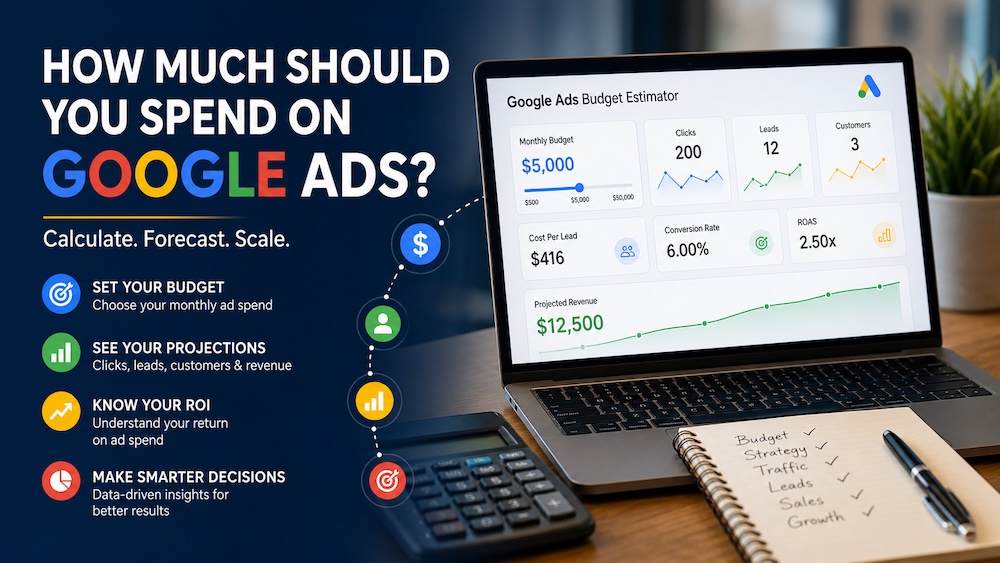
To help you find the right balance, we built a Google Ads Budget Estimator. It allows you to model your campaign before spending a dollar.
Simply select your industry, adjust your numbers, and instantly see your projected clicks, leads, customers, and return on ad spend.
Google Ads Budget Estimator
Calculate estimated clicks, leads, and ROI based on your monthly ad spend and industry.
Campaign Variables
Additional Costs (Optional)
Estimated Results
Based on your inputs, a $5,000 budget could generate ~5 new customers and $12,500 in revenue.
* Estimates based on entered numbers. Actual Google Ads results vary based on industry, location, competition, and tracking.
Understanding Your Calculator Results
This estimator uses real-world campaign logic combined with industry benchmarks to project what your budget can realistically produce.
Here is how each variable impacts your results.
Average Cost Per Click (CPC)
CPC is the amount you pay each time someone clicks your ad. Higher competition industries like legal services or HVAC often have significantly higher CPCs than lower competition markets like local retail or med spas. If your CPC is high, your budget will generate fewer clicks. That means your campaign must convert at a higher rate to remain profitable.
Website Conversion Rate
Getting traffic is only the first step. Your conversion rate determines how many of those visitors actually turn into leads. A strong landing page with clear messaging, trust signals, and fast load times can dramatically improve your results. A weak page can double or triple your cost per lead without you realizing it.
Lead Close Rate
Marketing generates opportunities. Your sales process determines how many of those opportunities turn into paying customers. If you close 30–40% of your leads, your campaign becomes far more profitable than a business closing 10–15%. This is one of the most overlooked variables in Google Ads performance.
Average Customer Value
Your average job value or customer lifetime value is what ultimately determines whether your campaign works. Higher-value services can sustain higher acquisition costs. Lower-value services require tighter efficiency.
Our team of experts is here to help you navigate the complex landscape and drive real results.
TALK TO AN EXPERT →Average Google Ads Cost Per Click by Industry
The cost of Google Ads varies significantly by industry. Below are typical CPC ranges based on benchmark data and keyword analysis.
- HVAC: $12 – $85
- Roofing: $10 – $60
- Plumbing: $10 – $80
- Dental: $2 – $20
- Personal Injury: $60 – $500
- Rehab / Addiction Treatment: $15 – $90
- Med Spa: $2 – $10
These ranges are used to pre-fill the calculator, but you can adjust them based on your specific market.
Example Google Ads Budget Scenarios
To make this more practical, here are a few simplified examples.
Example 1: Local HVAC Company
Monthly Budget: $5,000
Average CPC: $25
Conversion Rate: 6%
Close Rate: 30%
Average Job Value: $2,500
Estimated Outcome:
Clicks: 200
Leads: 12
Customers: 3–4
Revenue: $7,500 – $10,000
Example 2: Personal Injury Law Firm
Monthly Budget: $10,000
Average CPC: $120
Conversion Rate: 5%
Close Rate: 20%
Case Value: $15,000
Estimated Outcome:
Clicks: ~83
Leads: 4
Clients: 1
Revenue: $15,000
This is why high-CPC industries can still be profitable. One conversion can justify the entire spend.
Why Break-Even ROAS Is Your Most Important Metric
Many businesses focus on lowering cost per click. That is not the metric that determines success. Your break-even ROAS tells you how much revenue you need to generate to cover your ad spend.
Simple Example:
Monthly Ad Spend: $5,000
Revenue Generated: $10,000
ROAS = 2.0x
If your break-even point is 1.5x, your campaign is profitable. If it is 3.0x, you are losing money. Understanding this before launching a campaign helps you set realistic expectations and avoid wasted spend.
Common Google Ads Budget Mistakes
Most campaigns fail because of incorrect assumptions, not because Google Ads “doesn’t work.” Here are the most common mistakes:
- Focusing only on CPC instead of total return
- Ignoring conversion rate optimization
- Not tracking calls or form submissions properly
- Expecting immediate profitability without data
- Running ads without a defined close rate or sales process
Fixing these issues often improves performance without increasing budget.
What Affects Your Google Ads Budget?
Your actual costs will vary based on:
- Location and local competition
- Keyword intent and targeting
- Campaign structure and bidding strategy
- Landing page quality and speed
- Ad relevance and quality score
- Sales follow-up speed and effectiveness
The calculator gives you a directional estimate, but these factors ultimately determine your real-world performance.
Frequently Asked Questions
How much should I spend on Google Ads per month?
It depends on your industry and goals. Most small businesses start between $1,500 and $5,000 per month, while competitive industries often require $5,000 to $20,000+ to generate meaningful results.
Is $1,000 enough for Google Ads?
In most industries, $1,000 is not enough to generate consistent leads. It may work for testing or low-competition markets, but it typically will not produce reliable results.
What is a good cost per lead?
A good cost per lead depends on your customer value. If you generate $3,000 per customer, a $150 lead may be excellent. If your average sale is $200, that same cost would not be sustainable.
Why are Google Ads so expensive?
Google Ads is an auction. You are competing with other businesses for the same traffic. Higher competition and higher-value services naturally drive up costs.
Ready to Scale Your Campaigns?
Knowing your numbers is the first step. Most businesses already have enough budget to succeed. The issue is usually how that budget is being used.
If your projected results don’t align with your goals, the problem is not always spend. It is often your strategy, conversion rate, or sales process.
We help businesses improve the inputs that actually drive performance, from campaign structure to landing pages to conversion tracking.
If you are ready to turn your projections into real results, we can help you build a customized PPC strategy that scales.
Brand House builds campaigns around search intent, budget control, landing pages, conversion tracking, and lead quality — so you generate qualified leads instead of just buying traffic.
TALK TO AN EXPERT →