


Rehab lead generation is the process of attracting, qualifying, and converting individuals or families looking for addiction treatment into appropriate admissions.
The important word is appropriate.
A phone call is not automatically a good lead. A form submission is not automatically a real opportunity. If the person needs a level of care you do not provide, lives outside your service area, has coverage you cannot work with, or cannot reach your admissions team, the inquiry is unlikely to become an admission.
That is why effective rehab lead generation involves more than running ads or increasing website traffic. It connects marketing, landing pages, call tracking, clinical and financial qualification, admissions, and follow-up into one system.
The goal is not to generate the largest possible number of rehab leads. The goal is to generate more qualified treatment inquiries and give each appropriate person a clear path to care.
What Is Rehab Lead Generation?
Rehab lead generation includes the marketing and admissions processes used to reach people looking for addiction treatment and help them take the next step.
That may include:
- Search engine optimization
- Google Ads and Microsoft Ads
- Google Business Profile and local search
- Program and location landing pages
- Calls, forms, chats, and insurance verification requests
- Professional and community referrals
- Call tracking and CRM attribution
- Admissions response and follow-up
These pieces should not operate independently. A campaign can generate traffic, but the website still has to establish trust and explain the program. The website can generate calls, but admissions still has to answer, qualify, and follow up. If any part of the process breaks, marketing performance suffers.
This is one reason rehab marketing behaves differently from marketing for a typical local business. The decision is sensitive, the timeline can be short, family members are often involved, and the right treatment option depends on more than price or convenience.
Our team of experts is here to help you navigate the complex landscape and drive real results.
TALK TO AN EXPERT →What Counts as a Qualified Rehab Lead?
A qualified rehab lead is an inquiry with a realistic path to treatment at your facility.
The exact definition will vary by provider, but it normally includes several types of fit:
- Clinical fit: The person may be appropriate for the services and level of care offered.
- Financial fit: The person’s insurance or payment options align with the facility.
- Geographic fit: The person can reasonably access the program or receive the service in an approved location.
- Timing fit: The person is seeking help within a timeframe the facility can support.
- Capacity fit: The program has the staff, licensing, and availability needed to evaluate the inquiry.
- Contact fit: Admissions can reach the individual or decision-maker and continue the conversation.
Marketing should help with early qualification, but it should not make clinical decisions. The website can clearly describe programs, locations, accepted payment options, and who the facility is designed to help. The qualified clinical and admissions teams should handle screening, assessment, and placement.
That distinction matters. Good marketing creates clarity. It does not promise that every person is eligible or that every inquiry will become an admission.
Rehab Leads, Qualified Leads, and Admissions Are Different Metrics
Many treatment centers put every phone call and form submission into one lead total. That makes reporting look simple, but it does not show whether marketing is working.
Use clear stages instead:
| Stage | What it means | What to measure |
|---|---|---|
| Inquiry | Any new call, form, chat, or verification request | Cost per inquiry |
| Contacted inquiry | A person admissions successfully reached | Contact rate |
| Qualified lead | An inquiry meeting the facility’s defined fit criteria | Cost per qualified lead |
| Assessment | A clinical or admissions evaluation was completed | Assessment completion rate |
| Admission | The person entered the program | Cost per admission |
| Attributed revenue | Collected revenue tied to the original source | Revenue by source |
This prevents a campaign with many low-quality calls from appearing stronger than a campaign with fewer calls that produce more admissions.
Why Most Rehab Leads Do Not Convert
When lead generation underperforms, the immediate reaction is often to blame the traffic source. Sometimes the traffic is the problem. Often it is only one part of the problem.
The marketing targets the wrong intent
Broad addiction-related keywords can attract people looking for support groups, free resources, jobs, housing, detox, outpatient counseling, or services the facility does not offer.
More traffic will not fix that. Campaigns and pages need to match specific programs, locations, and levels of care.
The website is too vague
A page that says a facility provides compassionate, individualized care may sound good, but it does not answer the questions a visitor needs answered.
People want to know:
- What programs are offered?
- Where is treatment provided?
- Who does the program serve?
- What happens when they call?
- How does insurance verification work?
- Can a family member call on someone’s behalf?
If the website avoids useful details, admissions has to do all the filtering after the call.
Calls are missed or answered too slowly
People seeking treatment may contact several providers within a short period. A missed call, confusing phone tree, or delayed response can end the opportunity before qualification begins.
Coverage, routing, ownership, and follow-up are therefore part of the lead generation system. They cannot be treated as separate operational details.
And if coverage is an issue, you can also consider AI call center tools. You can learn more about what we think about treatment centers using AI for their call centers.
Marketing and admissions use different definitions
Marketing may optimize for calls longer than 60 seconds while admissions cares about completed assessments and admissions. Both teams can report success while the facility sees no meaningful growth.
The definition of a qualified lead should be documented and shared. Campaigns should then be optimized using actual disposition and admission data, not just platform conversions.
The source is not transparent
Purchased or shared drug rehab leads may be sold to multiple providers. The initial cost can look attractive, but the facility may have limited visibility into how the inquiry was generated, what the person was told, whether consent was handled properly, or how many other centers received the same information.
Third-party leads are not automatically bad, but they require more due diligence than owned channels.
The Rehab Lead Generation Funnel
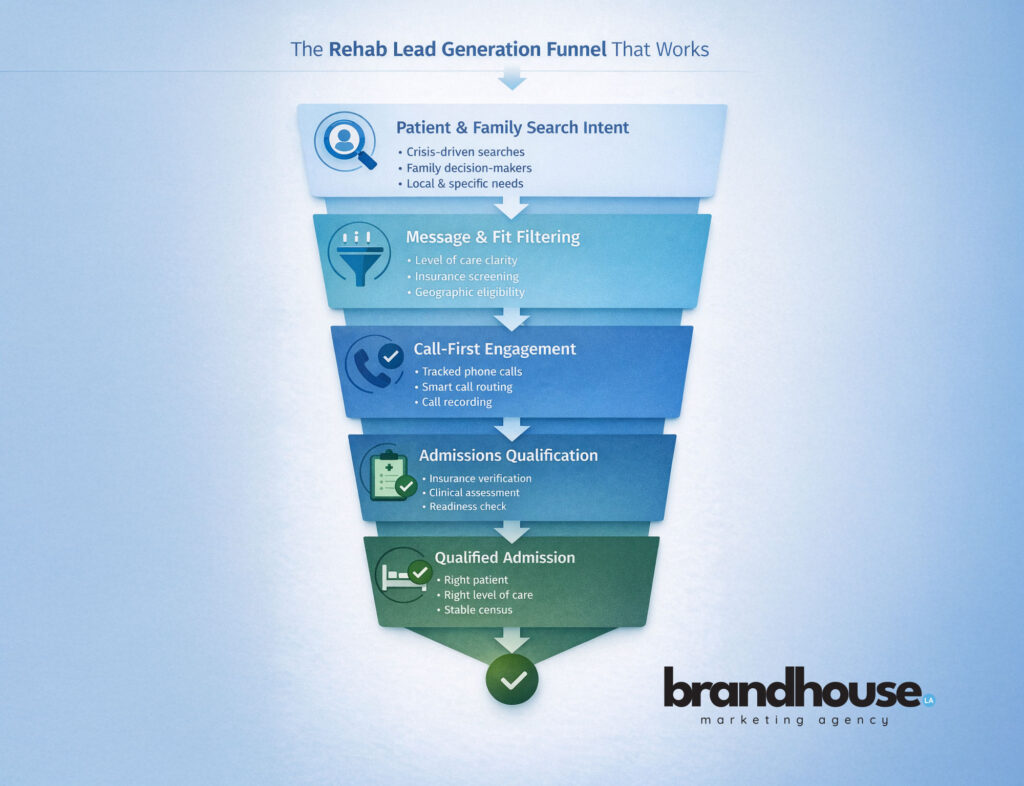
A useful funnel follows the full path from first contact to admission.
1. The person searches or receives a referral
The process may begin through Google, a map result, an advertisement, a professional referral, an alumni referral, or a community relationship.
The source affects intent. Someone searching for a specific residential program is in a different position from someone reading a general article about addiction.
2. The person reaches an intent-matched page
The page should match what brought the visitor there. An ad for outpatient treatment should not lead to a generic home page. A local search should lead to a real location or program page with accurate details.
3. The visitor calls, submits a form, starts a chat, or requests verification
Make the next step clear. On mobile devices, the phone option should be easy to use. Forms should ask only for information the team genuinely needs and is prepared to protect.
4. Admissions responds
Every inquiry needs an owner. Calls should route correctly, missed calls should create alerts, and form submissions should enter a defined follow-up process.
5. The inquiry is qualified
Admissions reviews clinical, financial, geographic, timing, and capacity considerations. The outcome should be recorded using consistent disposition categories.
6. The person completes the appropriate next step
Depending on the program, that may be an assessment, insurance verification, scheduling step, referral, or admission.
7. The outcome returns to marketing
Marketing should know which campaigns produced qualified inquiries and admissions. Without that feedback, platforms tend to optimize toward whichever conversion is easiest to generate, not necessarily the one that matters most.
Which Channels Generate Rehab Leads?
No single channel is right for every facility. The best mix depends on the programs offered, location, budget, timeline, reputation, and admissions capacity.
Our rehab marketing strategy guide explains how these channels work together.
| Channel | Speed | Level of control | Typical role |
|---|---|---|---|
| Google Ads | Fast | High when managed closely | Capture active treatment searches |
| Microsoft Ads | Fast | High | Supplement paid search reach |
| Organic SEO | Slower | High | Build durable visibility for programs, locations, and questions |
| Local SEO | Medium | Medium | Reach people looking for nearby treatment options |
| Professional referrals | Variable | Relationship-based | Generate trust-led inquiries through clinicians and partners |
| Alumni and family referrals | Variable | Relationship-based | Build reputation and word-of-mouth demand |
| Paid social | Medium | Medium | Support awareness and remarketing where permitted |
| Shared lead vendors | Fast | Often low | Supplement volume after careful compliance and quality review |
Paid search
Google Ads can reach people when they are actively looking for treatment. It can also waste money quickly when keywords, locations, search terms, and landing pages are too broad.
Strong rehab PPC advertising normally separates campaigns by program, intent, and location. It also connects calls and forms to downstream outcomes so budget decisions are based on lead quality and admissions, not clicks.
Paid search is usually strongest when the facility already has:
- Clearly defined programs and locations
- A realistic understanding of who it can serve
- Landing pages aligned with each campaign
- Reliable call and form tracking
- Admissions coverage during the hours campaigns run
- A process for reporting lead outcomes back to marketing
Search engine optimization
SEO takes longer, but it can build visibility across multiple stages of the decision process.
Program pages can target searches for specific treatment options. Location pages can support geographic searches. Educational articles can answer questions from individuals and family members who are still evaluating what to do.
Effective rehab SEO services should connect these pages into a clear structure. Publishing a large number of overlapping articles is not a substitute for building useful topical coverage.
The strongest content normally does one clear job:
- Explain a program
- Answer a real question
- compare relevant options
- Describe a location
- Explain the admissions process
- Help a family member understand the next step
Local search
Local visibility matters when a facility serves a defined area or when people search for treatment near a specific city.
The basics include:
- An accurate Google Business Profile
- Consistent name, address, and phone information
- Real program and location pages
- Appropriate categories and services
- Reviews handled with privacy and ethical considerations in mind
- Local citations and relevant links
Avoid creating thin city pages for places where the organization has no meaningful presence. A page should explain how the facility actually serves that market.
Professional and community referrals
Not every valuable lead begins online. Therapists, hospitals, interventionists, physicians, employee assistance programs, community organizations, and other providers can be important referral sources.
These relationships depend on trust, appropriate communication, and reliable follow-through. They should not be reduced to a list of contacts receiving generic outreach.
Lead vendors and pay-per-call
Lead vendors may create short-term volume, but treatment centers should review:
- How the inquiries are generated
- Whether leads are exclusive or shared
- What representations are made to consumers
- How consent is collected
- Which data is captured
- How data is stored and transferred
- Whether the vendor uses affiliates or subvendors
- How duplicates, wrong numbers, and ineligible inquiries are handled
- Whether contracts create legal, privacy, or patient-brokering concerns
If the vendor cannot clearly explain the source and handling of the leads, that is a serious problem.
Why Landing Pages Matter
Landing pages are not just places to put a form. They help people understand whether they may be in the right place before they speak with admissions.
A useful page should clearly explain:
- The program and level of care
- The location
- The populations served
- Important eligibility limitations
- Available payment or insurance-verification options
- What happens after someone contacts the facility
- How to call or request the next step
The page also needs to work well on mobile devices, load quickly, and make the phone number easy to find.
Specialized rehab website development should connect this information with analytics, call tracking, forms, privacy requirements, and the admissions workflow. A visually polished page that cannot be attributed or followed up is still incomplete.
Intake Is Part of Lead Generation
Marketing cannot produce an admission by itself. Admissions determines what happens after the inquiry arrives.
At minimum, treatment centers should define:
- Who answers new calls
- What happens after hours
- How overflow and missed calls are handled
- How quickly forms and chats receive a response
- Which questions are used for early qualification
- How inquiries are assigned
- How many follow-up attempts are appropriate
- Which disposition categories are recorded
- How referrals to other resources are handled
- How marketing receives outcome data
Call reviews can also reveal problems that campaign reports will never show. For example, a keyword may appear to produce strong calls, but recordings and admissions notes may show consistent insurance or level-of-care mismatch.
The point is not to have marketing manage admissions. The point is to give both teams enough shared information to improve the full process.
How to Measure Rehab Lead Generation
Start with a small set of numbers that connect spending to actual outcomes.
For setup options, see our guide to how call tracking works.
Contact rate
Contact rate = contacted inquiries / total inquiriesQualified lead rate
Qualified lead rate = qualified inquiries / total inquiriesAssessment completion rate
Assessment completion rate = completed assessments / scheduled assessmentsQualified lead-to-admission rate
Qualified lead-to-admission rate = admissions / qualified inquiriesCost per qualified lead
Cost per qualified lead = total channel cost / qualified inquiriesCost per admission
Cost per admission = total channel cost / attributable admissionsThe facility should define what is included in total channel cost. That may include media spend, management fees, creative work, landing pages, call tracking, and other direct acquisition costs.
Avoid comparing channels using different definitions. If SEO is measured using all assisted admissions but paid search receives credit only for last-click admissions, the comparison will be misleading.
A Practical 90-Day Improvement Plan
Days 1 through 15: Establish the baseline
- Document the definition of an inquiry, qualified lead, assessment, and admission.
- Audit phone numbers, forms, chat, call routing, and CRM capture.
- Review recent lead dispositions by source.
- Identify missing or inconsistent tracking.
Days 16 through 30: Fix messaging and qualification
- Map programs, locations, and important eligibility information.
- Compare campaign promises with what admissions can actually support.
- Rewrite vague landing-page sections.
- Make the next step clear on mobile and desktop.
Days 31 through 45: Clean up acquisition channels
- Separate paid campaigns by intent, program, and location.
- Review search terms and exclusions.
- Identify overlapping or low-value SEO pages.
- Review third-party lead sources and contracts.
Days 46 through 60: Improve admissions response
- Set call-routing and missed-call procedures.
- Assign ownership for every form and chat.
- Standardize disposition categories.
- Review a sample of qualified and unqualified calls.
Days 61 through 75: Strengthen the content system
- Improve core program and location pages.
- Add internal links between related resources.
- Publish content that answers real admissions questions.
- Add first-hand examples, expert review, and source citations where appropriate.
Days 76 through 90: Optimize using outcomes
- Compare channels using qualified leads and admissions.
- Identify the largest funnel drop-off.
- Move budget toward sources producing appropriate inquiries.
- Create a recurring marketing and admissions review.
Do not try to rebuild every channel at once. Fix the weakest part of the funnel first, then measure whether the change improves the next stage.
The lead-tracking spreadsheet template provides a starting point for organizing the agreed reporting stages.
Compliance and Privacy Cannot Be Added Later
Addiction treatment marketing operates in a sensitive and highly regulated environment. Requirements can vary based on the organization, service, location, technology, and type of communication.
Google classifies addiction services under its healthcare and medicines policy. Providers advertising recovery-oriented drug and alcohol services may need LegitScript certification and Google certification. Review the current Google Ads healthcare and medicines policy and LegitScript addiction treatment certification requirements before launching campaigns.
Privacy also affects forms, call tracking, analytics, remarketing, CRM systems, and vendor relationships. The U.S. Department of Health and Human Services states that regulated entities may not use tracking technologies in ways that result in impermissible disclosures of protected health information. Its guidance on online tracking technologies should be reviewed with qualified privacy and legal professionals.
Substance use disorder records may also be subject to additional confidentiality requirements under 42 CFR Part 2. SAMHSA provides an overview of the relevant statutes, regulations, and guidelines.
This article is marketing information, not legal or compliance advice. Treatment providers should have their specific practices, vendors, forms, tracking, call-recording procedures, and campaigns reviewed by qualified professionals.
Building a Sustainable Rehab Lead Generation System
The most reliable systems are built around ownership, clarity, and feedback.
The facility owns its brand, website, data, call experience, and admissions process. Marketing channels are selected based on the programs the organization can actually deliver. Landing pages explain what the facility offers. Admissions records what happened. That information returns to marketing so targeting and budgets can improve.
This creates a better cycle:
- Reach people with the right intent.
- Give them accurate and useful information.
- Make it easy to contact the facility.
- Respond consistently.
- Qualify appropriately.
- Measure the outcome.
- Improve the weakest stage.
Buying more traffic before this system is working usually creates more noise. Once the system is aligned, additional traffic has a better chance of producing qualified opportunities and admissions.
Frequently Asked Questions
What is the best source of rehab leads?
There is no single best source for every treatment center. Paid search can capture immediate demand, while SEO, local search, and professional referrals can build longer-term visibility and trust. The best source is the one that consistently produces appropriate inquiries and admissions at a sustainable cost.
Should treatment centers buy drug rehab leads?
Purchased leads can supplement owned marketing channels, but the provider should understand exactly how each inquiry was generated, whether it is shared, how consent and data handling work, and whether the arrangement complies with applicable laws and policies. Lack of transparency is a major warning sign.
Is SEO or PPC better for rehab lead generation?
PPC can produce visibility faster, but it requires ongoing media spend and tight campaign control. SEO usually takes longer but can build durable visibility across program, location, and educational searches. Many facilities use both for different parts of the acquisition strategy.
How should a rehab center track lead quality?
Track the source of every inquiry and use consistent outcomes such as contacted, qualified, assessment scheduled, assessment completed, admitted, referred, duplicate, wrong service, insurance mismatch, and unreachable. The categories should reflect the facility’s real admissions process.
Does every inquiry need an immediate response?
Every appropriate inquiry needs a defined response process. The exact timing and workflow will depend on staffing and clinical operations, but unanswered calls and unowned forms should not sit without alerts or follow-up responsibility.
Does a rehab center need LegitScript certification?
Providers that want to advertise addiction treatment services on certain platforms may need LegitScript certification as well as platform-specific approval. Eligibility and requirements can change, so review the current policies before launching or modifying campaigns.
Final Thoughts
Rehab lead generation is not about collecting as many phone numbers as possible. It is about creating a reliable path between people looking for help and a treatment program equipped to evaluate and serve them.
That requires more than marketing. Search intent, messaging, landing pages, tracking, admissions response, qualification, privacy, and follow-up all affect the result.
If your campaigns are generating activity without enough qualified inquiries or admissions, increasing the budget may not be the answer. Start by finding the weakest point in the funnel and fixing it.
Brand House helps addiction treatment providers review search visibility, paid advertising, websites, tracking, and the path from inquiry to admission. If you want a clear assessment of where opportunities are being lost, contact Brand House.
Brand House builds campaigns around search intent, budget control, landing pages, conversion tracking, and lead quality — so you generate qualified leads instead of just buying traffic.
TALK TO AN EXPERT →