
Finding low competition keywords with high traffic sounds simple. Open a keyword tool, sort by search volume, filter by keyword difficulty, and start writing.
That is usually where the problem starts.
A keyword can look easy in a keyword research tool and still be hard to rank for. It can have a lot of search volume and still bring the wrong visitors to your website. It can even rank well and still produce no leads.
The real goal is not just to find low competition keywords. The goal is to find keywords your website can realistically rank for, that your audience actually searches, and that have a clear connection to your services, products, or sales process.
In this guide, we will walk through how to find low competition keywords with high traffic potential without wasting time on topics that look good in a spreadsheet but do not help your business grow.
What Are Low Competition Keywords?
Low competition keywords are search terms that are usually easier to rank for compared to broader, more competitive keywords.
For example, a keyword like SEO is extremely broad and competitive. A small business website is probably not going to rank on page one for that term anytime soon.
But a more specific keyword like how to find low competition keywords with high traffic is more focused. The person searching has a clearer problem, the search results may be less competitive, and the content needed to satisfy the query is more specific.
That is what makes low competition keywords valuable. They give smaller websites a better chance to compete.
But there is an important catch. Low competition does not automatically mean it is a good keyword.
A good keyword should have:
- A realistic chance of ranking
- Clear search intent
- Enough traffic potential to matter
- A connection to your business
- A search result page that is not impossible to compete against
If a keyword checks all of those boxes, it may be worth targeting.
Our team of experts is here to help you navigate the complex landscape and drive real results.
TALK TO AN EXPERT →Why High Traffic Keywords Are Not Always Better
Most people start keyword research by looking for the highest-volume keywords. That makes sense on the surface. More searches should mean more traffic.
But high-volume keywords are often broad, competitive, and less specific.
For example, someone searching marketing could be looking for a definition, a college course, a job, a strategy, a book, a service provider, or a software tool. The intent is too broad.
Compare that to someone searching how much does SEO cost for a small business. That search has less volume, but the intent is much clearer. The person is likely researching a real service and may be closer to making a decision.
This is why keyword research should not be based on volume alone.
A smaller keyword with stronger intent can be more valuable than a high-volume keyword that attracts the wrong audience.
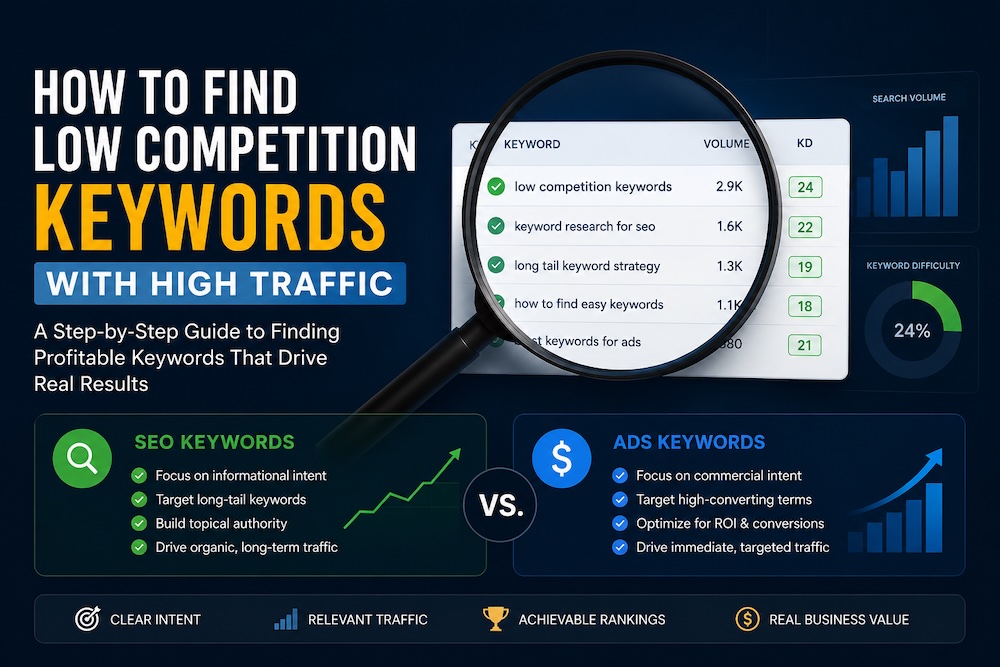
Low Competition Keywords for SEO vs Google Ads
Low competition keywords can mean different things depending on whether you are using them for SEO or Google Ads.
For SEO, keyword competition usually means how difficult it may be to rank organically on Google. You are looking at the websites already ranking on page one, the quality of their content, their authority, their backlinks, and how well they match the search intent.
For Google Ads, competition works differently. You are not trying to rank organically. You are entering an ad auction. A keyword may have low organic competition but still be expensive in paid search if advertisers are bidding aggressively because the keyword drives leads or sales.
That means a good SEO keyword is not always a good Google Ads keyword, and a good Google Ads keyword is not always the best SEO topic.
For example, a keyword like how to find low competition keywords with high traffic may be a strong SEO content topic because it answers an informational search and can support future leads. But for Google Ads, that same keyword may be too early in the buying journey unless you have a specific offer, tool, download, or consultation tied to it.
On the other hand, a keyword like SEO agency for small business may be highly competitive organically, but it could still be worth testing in Google Ads if the cost per click, conversion rate, and lead quality make sense.
If you are choosing keywords for SEO, focus on search intent, ranking difficulty, topical relevance, and traffic potential. If you are choosing keywords for Google Ads, focus more heavily on buyer intent, cost per click, conversion rate, and whether the keyword can produce profitable leads.
Step 1: Start With Topics That Are Close to Your Business
Before opening a keyword tool, start with your actual services, products, and customer questions.
For a small business, these topics might include:
- SEO services
- Google Ads management
- Website design
- Landing pages
- Lead generation
- Marketing budgets
- Conversion rate optimization
- Content strategy
These are not all keywords yet. They are topic areas.
From there, think about the questions someone might ask before they hire a company like yours.
For example:
- How much does SEO cost?
- How long does SEO take?
- How do I know if my SEO company is working?
- Should I run Google Ads or SEO first?
- How much should I spend on Google Ads?
- How many landing pages do I need?
This is where strong keyword research usually starts. Not with random volume. Not with trendy topics. With the questions that connect to the customer journey.
For example, a business owner researching organic growth may eventually need help with SEO services, while someone comparing paid traffic options may be better suited for Google Ads management.
Step 2: Use Keyword Tools to Expand the List
Once you have your main topics, use keyword research tools to find related searches.
You can use tools like:
- Google Search Console
- Google Keyword Planner
- Ahrefs
- Semrush
- Moz
- LowFruits
- AlsoAsked
- AnswerThePublic
You do not need every tool. One or two good sources are enough to start.
Look for keyword variations that include words like:
- how
- what
- why
- cost
- best
- near me
- for small business
- examples
- template
- calculator
- checklist
These modifiers usually reveal more specific search intent. They also tend to produce better content ideas than broad service keywords alone.
For example, someone searching for how much should a small business spend on Google Ads is not just looking for a definition. They are trying to understand budget, expectations, and whether paid search makes sense for their business. That type of search can connect naturally to a resource like how much a small business should spend on Google Ads.
Step 3: Look Beyond Keyword Difficulty
Keyword difficulty can be helpful, but it is not perfect.
Most SEO tools estimate keyword difficulty based on the strength of the websites ranking on page one, especially their backlinks. That gives you a rough idea of how competitive the keyword might be.
But keyword difficulty does not tell the full story.
A keyword with a low difficulty score can still be hard if the search results are filled with strong brands, government websites, national publications, or highly authoritative industry sites.
A keyword with a higher difficulty score may still be possible if the current results are outdated, thin, poorly matched to the search intent, or missing the exact answer people want.
Use keyword difficulty as a filter, not as the final decision.
For each keyword, ask:
- Who is currently ranking?
- Are they direct competitors?
- Are the top results strong brands?
- Is the content actually good?
- Is the search intent being fully answered?
- Can we create something more useful?
This is where you find the real opportunities.
Step 4: Analyze the Search Results Manually
Before choosing a keyword, search it yourself.
This is one of the most important steps. Tools can show you volume and difficulty, but the search results page shows you what Google is actually rewarding.
Look at the top-ranking pages and ask:
- Are they blog posts, service pages, category pages, videos, tools, or forums?
- Are the results informational or commercial?
- Are the top pages from huge brands or smaller websites?
- Do the articles fully answer the question?
- Are the pages fresh or outdated?
- Is there a featured snippet?
- Are there People Also Ask questions?
- Are there local results?
This will tell you what type of content you need to create.
For example, if every result is a blog post, you probably need a blog post. If every result is a calculator, you may need a calculator. If every result is a local service page, then a blog article may not be the right format.
Do not fight the search intent. Match it first, then make your page better.
Step 5: Check for Weak Results on Page One
A low competition keyword often has weak results on page one.
Weak results may include:
- Thin articles that barely answer the question
- Outdated content
- Forum threads ranking because no better page exists
- Generic articles from sites that do not specialize in the topic
- Pages that answer the keyword only partially
- Content with poor structure
- Pages with no examples, visuals, data, or clear process
If you see weak results, that is a good sign.
It means Google may not have many strong options for that query. If you can create a more complete, useful, and better-structured page, you may have a real chance to compete.
Step 6: Compare Search Volume With Traffic Potential
Search volume is useful, but it does not always show the full opportunity.
A keyword might show 100 searches per month, but the article could rank for dozens or hundreds of related long-tail keywords over time.
That is why you should think in terms of traffic potential, not just exact keyword volume.
For example, an article targeting how to find low competition keywords with high traffic might also rank for related searches like:
- How to find low competition keywords
- How to find easy keywords to rank for
- How to find high traffic keywords
- Low competition keyword research
- How to choose SEO keywords
- How to find keywords for blog posts
The main keyword might be the starting point, but the full article can capture a larger group of related searches.
This is why a strong content page should cover the topic naturally and completely, instead of repeating one keyword over and over.
Step 7: Score the Keyword Based on Business Value
Traffic is not the end goal. Revenue is.
Before choosing a keyword, ask how close it is to your business.
You can use a simple business value score:
- 3 = High value: The searcher may be close to buying or hiring.
- 2 = Medium value: The searcher has a problem related to your service, but may still be researching.
- 1 = Low value: The keyword may bring traffic, but the searcher is probably not a good customer.
- 0 = No value: The keyword has no real connection to your business.
For example, if you run an SEO agency, a keyword like how to tell if your SEO company is working would have high business value. The person searching may already be unhappy with their current provider.
A keyword like what is SEO may have more volume, but it is broader and usually lower intent.
That does not mean informational keywords are bad. It means you should know why you are targeting them.
If the keyword is related to a service you offer, such as search engine optimization, it may deserve a higher priority because the article can naturally support a future lead or consultation for your SEO services.
Step 8: Look for Keywords With a Clear Content Angle
Some keywords are hard to write because the angle is unclear.
Better keyword opportunities usually have a clear angle built into the search.
For example:
- How much does SEO cost? The angle is pricing.
- How long does SEO take? The angle is timeline.
- How to read an SEO report: The angle is education.
- How to find low competition keywords with high traffic: The angle is process.
- How to know if Google Ads are working: The angle is performance evaluation.
If the keyword gives you a clear structure, it is usually easier to create a useful page.
The same idea applies to paid search content. Someone trying to understand what PPC management includes is usually looking for a clearer explanation before they decide whether they need help managing campaigns.
Step 9: Prioritize Keywords You Can Answer Better Than the Current Results
This is where a lot of businesses get keyword research wrong.
They choose keywords because the numbers look good, not because they can actually create the best page.
Before targeting a keyword, ask:
- Do we have real experience with this topic?
- Can we explain it better than the current results?
- Can we add examples?
- Can we include a checklist, calculator, template, or framework?
- Can we make the answer more useful for our specific audience?
If the answer is yes, the keyword may be worth pursuing.
If the answer is no, it may not matter how low the difficulty score is.
For example, a topic like landing page length becomes more useful when it is not just about word count. It should explain sections, layout, offer complexity, and conversion intent. That is why a supporting article about how long a landing page should be can be more helpful than a basic answer that only gives a word count.
Step 10: Build a Keyword Prioritization Sheet
Once you have a list of possible keywords, put them into a simple sheet.
Use columns like:
- Keyword
- Search volume
- Keyword difficulty
- Search intent
- Business value
- Current ranking page type
- Competitor strength
- Content format needed
- Priority score
- Target URL
- Status
This keeps your SEO strategy organized.
Without a prioritization system, it is easy to chase random content ideas. A sheet helps you decide what to publish first and why.
A Simple Formula for Finding Good Keyword Opportunities
You can use this simple framework:
Good keyword opportunity = realistic ranking chance + clear intent + traffic potential + business value
If a keyword only has traffic, it is not enough.
If a keyword only has low competition, it is not enough.
If a keyword has low competition, useful traffic potential, and a direct connection to your business, it becomes much more valuable.
Example: Good vs Bad Keyword Choices
Let’s say you own a local digital marketing agency.
A keyword like marketing has a lot of volume, but it is too broad. It would be extremely competitive and the intent is unclear.
A keyword like how much does digital marketing cost for a small business has lower volume, but the intent is much stronger. The person searching is likely trying to understand budget, pricing, and whether they can afford help.
That second keyword may bring less traffic, but it can bring better traffic.
This is also why pricing-related content can be valuable. Someone researching digital marketing agency pricing is usually further along than someone searching a broad term like marketing tips.
The same logic applies to Google Ads. A broad keyword like advertising is probably too general, but a search around Google Ads budget planning shows clearer intent because the person is trying to understand what they may need to spend.
That is the type of tradeoff you should look for.
Common Mistakes When Looking for Low Competition Keywords
Only looking at keyword difficulty
Keyword difficulty is useful, but it should not be the only factor. Always review the search results manually.
Ignoring search intent
If the searcher wants a calculator and you write a basic article, you may struggle to rank. Match the intent first.
Choosing keywords that do not connect to your business
Traffic that cannot become leads, customers, subscribers, or brand awareness may not be worth the effort.
Writing thin content for long-tail keywords
Low competition does not mean low quality. You still need to create a useful page.
Targeting too many unrelated topics
Your website builds topical authority over time. Publishing random articles across unrelated subjects can weaken your focus.
How Many Low Competition Keywords Should You Target?
Start with a focused group of keywords around one topic cluster.
For example, instead of publishing one article about SEO, one about email marketing, one about social media, and one about branding, you may be better off building a cluster around SEO strategy.
That cluster could include:
- How to find low competition keywords with high traffic
- How to find low hanging fruit keywords
- How to forecast SEO growth
- How many blog posts do you need for SEO?
- How often should you blog for SEO?
- How to read an SEO report
- How to tell if your SEO company is working
This gives your website a clearer topical focus. It also gives you more internal linking opportunities.
What to Do After You Find the Right Keywords
Finding the keyword is only the first step.
After that, you still need to create the page properly.
That means:
- Writing a clear title and H1
- Matching the search intent
- Answering the main question early
- Using helpful subheadings
- Adding examples
- Including internal links
- Making the page easy to scan
- Optimizing the meta title and meta description
- Reviewing the page after it has had time to collect data
SEO content is not just about publishing. It is about publishing the right page, watching how it performs, and improving it over time.
If your website already has important service pages, blog posts can support those pages by answering earlier-stage questions and then sending readers to the next logical step. For example, a business owner reading about keyword research may eventually need help with SEO strategy and execution, while someone comparing paid traffic options may be better served by learning more about Google Ads management.
Final Thoughts
Low competition keywords with high traffic potential are valuable because they give your website a realistic path to growth.
But the best keywords are not always the ones with the biggest search volume. They are the ones where the search intent is clear, the competition is beatable, and the topic connects to your business.
If you are a small business, this matters even more. You probably do not have the authority, budget, or content history to compete for the biggest keywords right away. That does not mean SEO cannot work. It means your keyword strategy needs to be sharper.
Start with specific topics. Look for weak results. Focus on intent. Prioritize business value. Then create content that is genuinely more useful than what is already ranking.
That is how you find keyword opportunities that can actually turn into traffic, leads, and long-term SEO growth.
Need Help Finding the Right SEO Keywords?
Brand House helps small and medium-sized businesses build SEO strategies around realistic ranking opportunities, not random keyword lists. If you want to understand which keywords are actually worth targeting for your business, we can help you identify the best opportunities and turn them into a content plan.
Learn more about our SEO services.
Brand House builds campaigns around search intent, budget control, landing pages, conversion tracking, and lead quality — so you generate qualified leads instead of just buying traffic.
TALK TO AN EXPERT →