
Most people ask this question because they want to know whether a landing page should be short and simple or long and detailed.
That is the right question to ask, but the answer is not only about word count.
A landing page should be long enough to explain the offer, build trust, answer the visitor’s main questions, and get them to take action. But it should also be short enough to avoid distracting people from the conversion goal.
So, how long should a landing page be?
For many campaigns, a landing page will fall somewhere between 500 and 1,000 words. Simple offers may need fewer than 300 words. More complex, expensive, or high-trust offers may need 1,200 words or more.
The better rule is this: your landing page should be as long as the decision requires.
If the visitor already understands the offer and the action is low commitment, the page can be short. If the visitor needs more proof, more explanation, or more trust before taking action, the page usually needs to be longer.
Quick Answer: How Long Should a Landing Page Be?
A landing page should usually be between 500 and 1,000 words, but the right length depends on the offer, audience, traffic source, and conversion goal.
A short landing page can work well for simple offers, warm traffic, newsletter signups, downloads, and discounts. A longer landing page usually works better for paid ad campaigns, high-ticket services, B2B offers, healthcare, legal, finance, addiction treatment, and other decisions that require more trust.
Length is not only about the number of words. It is also about the number of sections, the amount of imagery, the depth of explanation, the proof needed, and how easy the page is to scan.
| Landing Page Type | Suggested Length | Best For |
|---|---|---|
| Short landing page | Under 300 words | Simple offers, downloads, email signups, warm traffic |
| Medium landing page | 300 to 600 words | Lead generation, free consultations, trials, simple service offers |
| Long landing page | 600 to 1,200+ words | Paid ads, high-ticket services, B2B, healthcare, legal, complex offers |
| Very long landing page | 1,200+ words | Cold traffic, expensive offers, detailed sales pages, high-trust decisions |
Our team of experts is here to help you navigate the complex landscape and drive real results.
TALK TO AN EXPERT →The Real Rule: Match the Length to the Decision
The length of a landing page should match how much convincing the visitor needs before taking action.
If the decision is easy, the page can be short.
If the decision is expensive, personal, risky, or complex, the page usually needs to be longer.
For example, someone downloading a free checklist does not need the same amount of information as someone booking a consultation for a high-ticket service. A visitor claiming a simple discount does not need the same amount of proof as someone researching a medical procedure, legal service, or addiction treatment provider.
The goal is not to make the landing page short or long.
The goal is to give the visitor enough information to take the next step without adding unnecessary friction.
Landing Page Length Is About Sections, Not Just Word Count
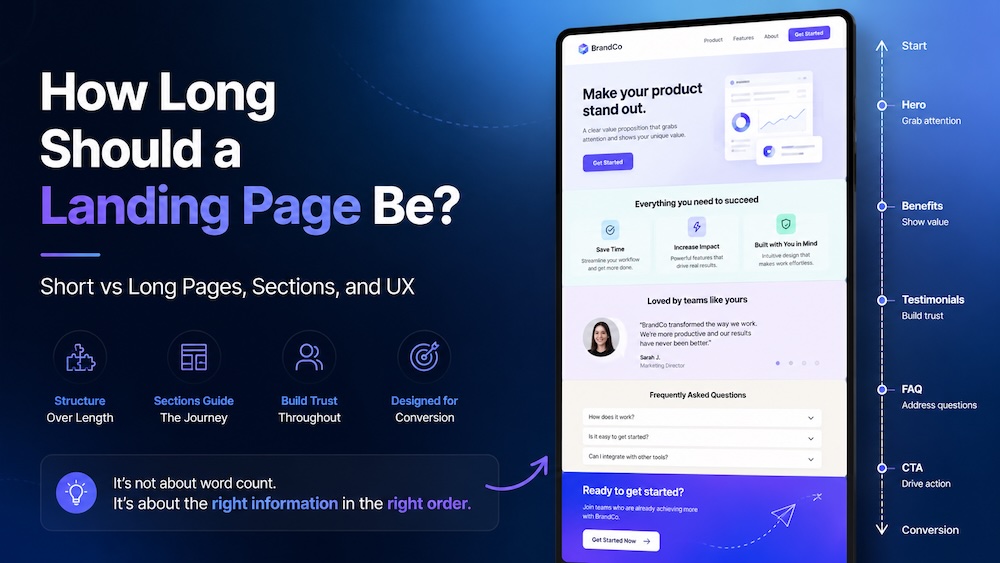
A landing page should not feel like a blog post. Even if the page has 800 or 1,200 words, those words should be broken into clear sections that move the visitor toward a decision.
The hero section should be short. It should quickly explain the offer, the main benefit, and the next step. It should not try to explain everything on the page.
Longer explanations usually belong lower on the page, after the visitor understands the offer and wants more detail.
This is where many landing pages go wrong. They either try to say too much at the top, or they make the whole page feel like one long block of text.
A better landing page is organized into sections.
| Landing Page Section | Typical Length | Purpose |
|---|---|---|
| Hero section | 25 to 75 words | Explain the offer quickly and give one clear call to action |
| Problem or pain point section | 75 to 150 words | Show the visitor you understand why they are there |
| Benefits section | 100 to 250 words | Explain what the visitor gets and why it matters |
| How it works section | 75 to 200 words | Reduce confusion and explain the process |
| Social proof section | 50 to 200 words | Add testimonials, reviews, logos, results, or trust signals |
| Details section | 150 to 400 words | Explain features, services, pricing, inclusions, or important decision factors |
| FAQ section | 150 to 500+ words | Handle objections and answer questions without crowding the main sections |
| Final CTA section | 25 to 75 words | Repeat the offer and make the next step easy |
This structure matters because people scan before they read.
A landing page can be long, but it should still feel easy to move through.
How Long Should the Hero Section Be?
The hero section should usually be short. In most cases, the hero section should be around 25 to 75 words.
It should answer three questions quickly:
- What is being offered?
- Why should the visitor care?
- What should they do next?
A hero section should not be 600 words. If the top of the page is overloaded, the visitor may never reach the rest of the landing page.
A strong hero section usually includes:
- a clear headline
- a short supporting sentence
- one primary call to action
- a visual, form, or trust signal when appropriate
The hero should create enough interest for the visitor to keep going or take action immediately.
When a Short Landing Page Works Best
A short landing page usually works best when the offer is simple and the visitor does not need much convincing.
This might include:
- email newsletter signups
- ebook or checklist downloads
- webinar registrations
- simple discounts
- basic event signups
- warm retargeting traffic
Short pages are often under 300 words and may only need one or two scrolls.
A short landing page should usually include:
- a strong headline
- a short explanation of the offer
- a few bullet-point benefits
- one form or button
- one simple trust signal if needed
Short landing pages can convert well when the offer is obvious and the audience already understands the value.
But short does not mean empty. A short page still needs a clear message, a clear reason to act, and a clean conversion path.
When a Medium-Length Landing Page Works Best
A medium-length landing page usually works well for standard lead generation, free consultations, software trials, quote requests, and simple service offers.
These pages are often around 300 to 600 words.
This length gives you enough room to explain the offer without making the page feel heavy.
A medium-length landing page may include:
- a clear hero section
- three to five benefits
- a short explanation of how the service works
- a testimonial or review
- a simple FAQ section
- one or two calls to action
This is often a good starting point for small business landing pages, especially when the offer needs some explanation but is not overly complex.
When a Long Landing Page Works Best
A long landing page usually works best when the visitor needs more information before they are ready to act.
This is common for:
- high-ticket services
- B2B offers
- healthcare services
- legal services
- financial services
- complex software
- multi-step sales processes
- addiction treatment marketing
Long landing pages are often 600 to 1,200 words or more.
That does not mean the page should feel bloated. It means the page needs enough sections to handle the visitor’s concerns.
A longer landing page may need:
- a stronger proof section
- more detailed service explanations
- testimonials or case studies
- process breakdowns
- comparison sections
- FAQs
- multiple CTAs throughout the page
Longer pages work when the added content helps the visitor make a decision. They do not work when the added content is just filler.
How Landing Page Length Changes for Paid Ads
Landing pages for paid ad campaigns need to be especially focused because every click costs money.
That does not automatically mean the page should be short.
A paid ad landing page should be long enough to support the search intent, the offer, and the level of trust needed to convert.
For example, a simple discount offer from a brand the visitor already knows may only need a short landing page. A cold Google Ads visitor searching for a high-value service may need more detail, proof, and reassurance before submitting a form or making a call.
The page should also match the ad. If the ad promises a specific service, location, offer, or benefit, the landing page should make that clear quickly.
This is why landing page structure is often part of PPC management, not just website design.
If you are sending paid traffic to a page, the length should support conversion. It should not force the visitor to dig for the reason they clicked.
Images and Layout Also Affect Landing Page Length
Landing page length is not only about words. Images, icons, forms, testimonials, videos, comparison tables, and spacing all affect how long the page feels.
A 1,000-word landing page can feel easy to read if it is broken into short sections with clear headings, helpful visuals, bullet points, and repeated calls to action.
A 500-word landing page can feel long if the content is dense, the sections are poorly organized, or the visitor has to work too hard to understand the offer.
Good imagery should support the message. It can show the product, explain the process, build trust, or help visitors understand what happens next.
Bad imagery can make the page feel longer without making it more useful.
Imagery should not be added just to fill space. The goal is not to make the page longer. The goal is to make the decision easier.
What Should Be Above the Fold?
The top of the landing page matters because it sets the direction for the rest of the page.
Above the fold, visitors should be able to understand:
- what the offer is
- who it is for
- why it matters
- what action they should take next
This does not mean every detail must be above the fold.
The job of the top section is to create clarity and momentum. The rest of the landing page can build proof, answer questions, explain details, and reduce hesitation.
For most landing pages, the above-the-fold section should include:
- a specific headline
- a short value proposition
- a primary CTA
- a relevant image, form, or trust signal
How to Make a Long Landing Page Feel Shorter
A landing page can be long without feeling overwhelming.
The key is to make the page scannable.
To make a long landing page easier to read, use:
- short paragraphs
- clear section headings
- bullet points
- benefit-focused copy
- helpful images or graphics
- testimonials or proof blocks
- comparison tables when useful
- FAQs near the bottom
- CTA buttons throughout the page
A long page should not ask the visitor to read every word to understand the offer.
The visitor should be able to skim the page and still understand what you do, why it matters, why they should trust you, and what they should do next.
What Sections Should a Landing Page Include?
The sections you include should depend on the offer and the amount of trust required.
A simple landing page may only need a few sections:
- hero section
- benefits
- form or CTA
- basic proof
A more complete landing page may need more sections:
- hero section
- problem section
- benefits
- how it works
- service or product details
- testimonials
- case studies or results
- trust signals
- FAQ
- final CTA
You do not need every section on every landing page.
The right structure depends on what the visitor needs to know before taking action.
Does a Longer Landing Page Convert Better?
Not always.
A longer landing page can convert better when the added content answers important questions, builds trust, and removes objections.
A longer landing page can convert worse when it adds unnecessary information, creates confusion, slows the page down, or distracts from the CTA.
The same is true for short landing pages.
A short landing page can convert well when the offer is simple and the audience is ready. A short landing page can fail when the visitor needs more information before taking action.
The question is not whether short or long is better.
The question is whether the page gives the visitor the right amount of information for the decision you are asking them to make.
How Landing Page Length Can Affect Cost
Landing page length can also affect cost. A short page with a simple form may be cheaper to build than a longer page with custom copy, proof sections, FAQs, tracking, and integrations.
A longer landing page may require more copywriting, design sections, imagery, development time, and quality assurance.
If you are budgeting for the page itself, see our guide on how much it costs to build a landing page.
The point is not that longer pages are always more expensive or better. The point is that more sections usually create more work.
How to Test Landing Page Length
The best way to know the right length is to test it.
You can test a shorter version against a longer version to see which one produces better results.
When testing landing page length, look at more than form submissions. Review:
- conversion rate
- cost per lead
- qualified lead rate
- scroll depth
- form starts
- phone calls
- booked appointments
- closed customers
This matters because the shortest page is not always the best page. The page with the most form submissions is not always the best page either.
If a longer page produces fewer leads but better qualified leads, it may be the stronger page.
This is also why it is important to track results beyond surface-level conversion numbers.
Landing Page Length and Google Ads Budget
If you are running Google Ads, landing page length can affect how efficiently your budget works.
A weak landing page can waste clicks. A page that is too thin may not give visitors enough reason to convert. A page that is too long or confusing may cause people to leave before taking action.
The right landing page length can help improve conversion rate, which may help lower cost per lead over time.
If you are still planning your ad spend, we also have a Google Ads budget estimator that can help you think through budget, clicks, conversion rate, and lead volume.
Your landing page does not replace a good campaign structure, but it can directly affect what happens after the click.
Final Answer: How Long Should Your Landing Page Be?
Your landing page should be as long as it needs to be to explain the offer, build trust, and get the visitor to take action.
For simple offers, that may be under 300 words.
For standard lead generation, 300 to 600 words may be enough.
For paid ads, high-ticket services, B2B, healthcare, legal, financial services, or complex offers, 600 to 1,200+ words may be more realistic.
But word count is only part of the answer.
The page also needs the right sections, imagery, layout, proof, CTAs, and tracking. A long landing page should not feel like a long article. It should feel like a clear path toward a decision.
Brand House builds landing pages around the campaign, the offer, the visitor’s intent, and the conversion path. That means the page length is based on what the visitor needs to take action, not a random word count.
FAQs
How long should a landing page be?
A landing page should usually be between 500 and 1,000 words, but the right length depends on the offer, audience, and conversion goal. Simple offers can use shorter pages, while complex or high-ticket offers usually need longer pages.
Is a short landing page better?
A short landing page can be better when the offer is simple, the audience is warm, and the action is low commitment. It may not work as well when the visitor needs more information, proof, or trust before converting.
Is a long landing page better?
A long landing page can be better for high-ticket, complex, or high-trust offers. Longer pages give you more room to explain the offer, answer objections, show proof, and include FAQs. But a long page only works if the extra content is useful.
How long should a landing page hero section be?
A landing page hero section should usually be around 25 to 75 words. It should quickly explain the offer, the main benefit, and the next step. It should not try to explain the entire page.
How many sections should a landing page have?
A simple landing page may only need three or four sections, such as a hero, benefits, proof, and CTA. A more complex landing page may need sections for the problem, benefits, process, testimonials, details, FAQs, and multiple CTAs.
Should a PPC landing page be short or long?
A PPC landing page should be long enough to match the visitor’s intent and support the conversion. Simple offers may need shorter pages. High-ticket services, cold traffic, or complex offers usually need more detail and proof.
Do images count toward landing page length?
Images do not count as words, but they affect how long the page feels. Helpful imagery can make a landing page easier to scan and understand. Generic or unnecessary imagery can make the page feel longer without improving conversions.
How do I know if my landing page is too long?
Your landing page may be too long if visitors stop scrolling, miss the CTA, get distracted, or leave before taking action. The issue is usually not the length alone. It is whether the content is organized clearly and helping the visitor make a decision.
Brand House builds campaigns around search intent, budget control, landing pages, conversion tracking, and lead quality — so you generate qualified leads instead of just buying traffic.
TALK TO AN EXPERT →