
Most businesses think marketing ends when a lead comes in.
A form submission. A phone call. A booked appointment.
But that is not where marketing ends. That is where the next part of the funnel begins. If your business is investing in Google Ads, SEO, or any type of lead generation, your results are not only determined by how many leads you generate. They are also shaped by what happens after someone reaches out.
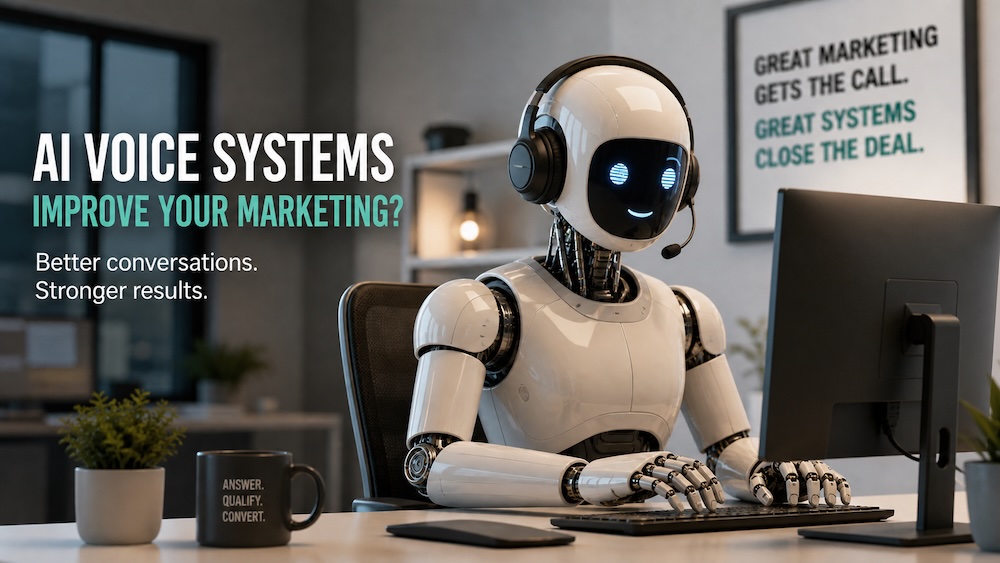
This is where AI voice systems have started to get more attention. They promise to answer calls, qualify leads, book appointments, and reduce the number of missed opportunities.
The question is not whether the technology is impressive. The real question is whether AI voice actually improves your marketing results.
Marketing Does Not End at the Click
Most campaigns are measured by clicks, impressions, cost per lead, and conversion rates. Those numbers matter, but they do not tell the whole story.
A campaign can look strong on paper and still fail if the follow-up process is weak. Someone can click your ad, call your business, and still never become a customer if the call is missed, handled poorly, or routed to the wrong person.
That means your marketing performance is affected by more than your ads or website. It is also affected by speed, consistency, and the quality of the conversation once a lead reaches your business.
Our team of experts is here to help you navigate the complex landscape and drive real results.
TALK TO AN EXPERT →Where Most Businesses Lose Leads
In many businesses, the biggest losses do not happen because the campaign failed to generate interest. They happen because the lead was not handled properly after it came in.
Common issues include missed calls during busy hours, calls going to voicemail after hours, slow response times, inconsistent information from staff, and poor lead qualification.
Even a small gap in call handling can become expensive. For example, if a business receives 100 calls per month and 30 of those calls are missed or poorly handled, that is 30 potential opportunities lost or weakened before the sales process even begins.
If just a few of those calls could have turned into customers, the revenue impact can be significant. This is the gap AI voice systems are trying to solve.
Where AI Voice Systems Can Help
AI voice can be useful when the call flow is simple and the business has a clear process for what should happen next.
For example, an AI voice system may be able to answer after-hours calls, collect basic contact information, ask what service the caller needs, qualify the lead, route the call, or schedule an appointment.
That can be helpful for businesses that miss calls because staff are busy, unavailable, or unable to answer every inquiry quickly.
AI can also support live staff instead of replacing them. In some setups, AI can help guide the person taking the call by surfacing questions, reminders, or information during the conversation. That type of use case can improve consistency without removing the human element.
Where AI Voice Systems Can Break Down
This is where businesses need to be careful.
AI voice systems can sound impressive in a demo, but real calls are messy. People interrupt. They talk over each other. They call from noisy environments. They explain things out of order. They ask questions the system was not prepared for.
That is when problems can happen.
Some of the most common issues include awkward pauses, overlapping conversations, repeated questions, incorrect responses, and the AI misunderstanding what the caller actually needs.
There is also the risk of hallucination. If the system is not given enough structure, it may say things your business does not offer, give inaccurate information, or go off script in a way that creates confusion.
For some callers, the frustration factor is enough to lose the opportunity. If someone realizes they are speaking with AI and the experience feels clunky, they may hang up and call a competitor.
Not Every Business Should Use AI Voice the Same Way
AI voice is not equally useful for every business or every industry.
It can work well for simple intake, basic appointment scheduling, after-hours coverage, and overflow calls. These are situations where the caller has a clear need and the next step is easy to define.
It becomes more complicated when the call requires trust, nuance, emotional judgment, or industry-specific sensitivity.
Legal, medical, addiction treatment, financial, and other high-stakes industries need to be especially careful. In those environments, the wrong answer is not just inconvenient. It can create risk, damage trust, or cost the business a serious opportunity.
The Best Use Case May Be a Hybrid Model
The strongest use of AI voice is usually not replacing people completely. It is using AI to support the parts of the call process that are repetitive, predictable, or easy to route.
For example, AI may handle the first layer of response, gather basic details, and determine whether the caller needs to speak with a live person. From there, high-value or complex calls can be passed to a human.
This type of hybrid model gives the business more coverage without asking AI to do too much.
That distinction matters. AI voice works best when it has a narrow job and clear boundaries. The more open-ended the conversation becomes, the more likely the system is to struggle.
What Businesses Should Track Before and After Using AI Voice
If you are considering AI voice, do not only track how many calls were answered. That number can look better while actual lead quality gets worse.
Instead, look at the full call-to-customer path.
- How many calls were answered?
- How many calls turned into qualified leads?
- How many qualified leads booked appointments?
- How many appointments turned into customers?
- How many callers dropped off or asked for a human?
- How often did the AI provide incorrect or incomplete information?
This is where businesses get a clearer picture. AI voice should not just make call metrics look better. It should help improve the actual business outcome.
Can AI Voice Improve Your Marketing?
Yes, but only when the problem is tied to call handling, response time, or lead follow-up.
AI voice will not fix weak targeting, poor offers, bad landing pages, or campaigns that are attracting the wrong audience. If the marketing strategy is broken before the call happens, AI will not solve the core problem.
But if your marketing is already generating calls and your business is missing opportunities because of slow response, inconsistent intake, or after-hours gaps, AI voice may help you capture more of the demand you are already creating.
That is the right way to think about it. AI voice is not a replacement for marketing. It is part of the system that supports what happens after marketing creates interest.
Final Thoughts
AI voice systems can help businesses improve their marketing results, but they are not a magic fix.
The technology works best when the call process is simple, the instructions are clear, and there is a plan for when the caller needs a human. It works poorly when businesses expect it to handle every conversation perfectly without structure, oversight, or maintenance.
For some businesses, AI voice can reduce missed opportunities and improve speed to lead. For others, it can create frustration and hurt trust.
The businesses that get the most value from it will be the ones that treat AI voice as part of a larger lead handling system, not as a replacement for human judgment.
Brand House builds campaigns around search intent, budget control, landing pages, conversion tracking, and lead quality — so you generate qualified leads instead of just buying traffic.
TALK TO AN EXPERT →